




Recent Posts
 Choosing a Gas Permeability Tester: Range, Resolution, and Film TypesNov 28, 2026
 What Does a Gas Transmission Rate Tester Measure in Barrier Films?Nov 28, 2026
 ASTM D1434 vs. D3985: Choosing a Gas Transmission Test for Barrier FilmsNov 28, 2026
 What does an adhesive tack tester measure in medical dressings?Nov 28, 2026
 What Does a Horizontal Release Liner Tester Measure in a Peel Test?Nov 28, 2026


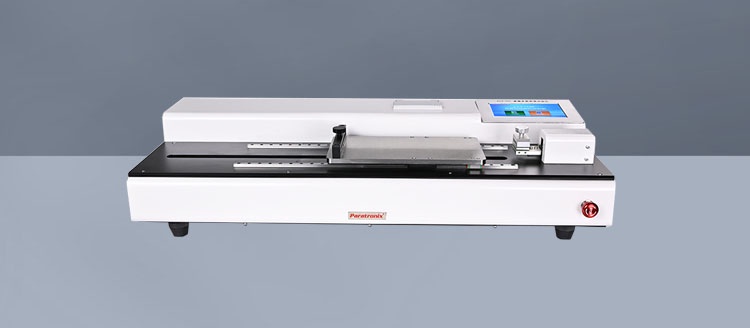
An adhesive tack tester for medical dressings measures the force associated with separating an adhesive from a test surface after a short, controlled contact. Depending on the method, the reported result may be the peak separation force or another value derived from the force–displacement curve. It describes initial adhesion under specified conditions, not the dressing’s complete performance on a patient.
This distinction matters when a dressing feels easy to apply but lifts soon afterward, or when two adhesive formulations seem similar by touch. A tack test can reveal differences in their initial grip, provided the contact surface, pressure, time and separation conditions are controlled. The result alone cannot establish wear time, skin compatibility or whether removal will be comfortable.
The measurement: initial grip after brief contact
Tack is the ability of an adhesive to form a bond quickly when it touches a surface under relatively light pressure. A tester brings the dressing adhesive into contact with a specified surface and then separates the two while measuring force. The instrument records resistance during separation; in many methods, the highest force reached is the principal tack result.
In a probe tack test, for example, a probe contacts the exposed adhesive for a defined period. When the probe withdraws, a load cell records the force required to pull it away. A higher peak indicates greater resistance to separation under that particular test setup. It does not necessarily mean the adhesive will hold better throughout the intended period of use.
Some instruments also produce a force–displacement curve. Its peak shows the maximum force, while the shape can indicate how separation progresses. The area under the curve may be used to calculate separation work when the method and instrument support that calculation. Peak force and separation work describe different features of the test and should not be treated as interchangeable.
Results may be reported as force, such as newtons, or normalized to contact area when the selected method calls for it. Normalization does not automatically make results comparable: the actual contact area and how it was established still matter. A nominal probe area, for instance, may differ from the area that genuinely bonded to a textured or uneven adhesive.
What happens during a tack test?
The sequence is straightforward, but small changes at each stage can alter the result. A typical probe-based procedure follows this pattern:
- Prepare the specimen. Cut or position the dressing so the adhesive can be exposed without stretching, wrinkling or contaminating the test area. Remove the release liner according to the defined procedure.
- Prepare the contact surface. Use the specified probe or substrate, with a consistent cleaning procedure and surface condition. Residue from an earlier test can change the next measurement.
- Establish contact. Bring the surface and adhesive together at the prescribed speed and contact force or pressure, then maintain contact for the specified dwell time.
- Separate and record. Withdraw at the specified speed while the instrument records force against time or displacement.
- Examine the result. Record the reported value, the curve where available, and observations such as adhesive residue or unusual specimen movement.
The procedure should also define how many specimens to test, how to handle outliers and which part of the dressing to sample. This is especially useful for products with patterned adhesive, perforations or a border surrounding an absorbent pad. A probe placed over a different feature may encounter a different adhesive area or backing support.
Test method changes the meaning of the number
“Tack” is not measured by one universal motion. Probe tack is a common approach, but loop tack and rolling-ball tack use different specimen arrangements and physical actions. Their results answer related questions, not identical ones.
The dressing construction helps determine which approach is practical. A thin adhesive film, a soft silicone layer and a stiff bordered dressing may not all form the same contact in a loop or under a probe. The selected method should be appropriate for the material and the question being investigated, rather than chosen simply because it produces a convenient number.
Published test methods may be relevant to pressure-sensitive adhesives, but their applicability to a particular dressing and test substrate should be checked. Record the exact method and any departures from it. Two results labeled “tack” should not be compared directly unless their methods and conditions are sufficiently alike.
Why the contact surface matters for dressings
Medical dressings are intended to interact with skin, yet a laboratory tack result is often obtained on a defined artificial surface. A smooth metal or polymer surface can support repeatable comparisons because its condition can be controlled. It is still a model surface, not a direct representation of living skin.
Skin varies in texture, moisture, oils, hair, curvature and movement. The adhesive may contact only part of a surface at first, then conform more closely with time and application pressure. A smooth, rigid probe can create a different contact pattern from a dressing applied to a flexible body site. A value measured on that probe therefore should not be described as the dressing’s “skin tack” without qualification.
Skin-like substrates can be useful when the purpose is to explore a particular application condition, but they also need a defined composition, preparation and replacement procedure. Results from different surrogate materials are not automatically equivalent to one another or to results from human skin. Tests involving human skin require an appropriate protocol and relevant ethical and safety review; an instrument reading does not replace that framework.
Conditions that can change a tack result
Contact time and application force
Longer contact or greater pressure can allow the adhesive to make more intimate contact with the surface. The effect depends on the adhesive and backing. When comparing formulations, hold dwell time and contact force or pressure constant; otherwise, an apparent material difference may reflect the way contact was made.
Contact speed also matters. A rapid touch can create a different initial contact from a slow approach, particularly with soft materials. Record the approach conditions as well as the separation conditions, even when the final report emphasizes only peak force.
Separation speed and direction
Pressure-sensitive adhesives can respond differently to fast and slow separation. A result obtained at one withdrawal speed should not be assumed to predict a result at another. The direction of separation also matters: pulling a probe away normal to the surface is not the same action as peeling a dressing edge back at an angle.
That difference is important when investigating removal. A tack test may help compare initial contact behavior, but it is not a substitute for a properly defined peel test or an assessment of removal on the intended surface.
Temperature, humidity and conditioning
Adhesive properties can change with temperature, while humidity may affect some materials and surfaces. Specimens should be conditioned and tested under the conditions specified by the chosen method, with the actual environment recorded. Time between liner removal and testing should also be controlled, because exposure or handling may alter the adhesive surface.
Storage history can complicate comparisons. When investigating a change between batches, check whether the samples had comparable packaging, storage and conditioning histories before attributing a difference to formulation alone.
Specimen and fixture behavior
A flexible backing can stretch, bend or lift during separation. A soft dressing may compress unevenly; a small specimen may shift in its fixture. These movements become part of the measured response. Secure the specimen consistently without deforming the adhesive area, and inspect whether the failure occurred at the intended interface.
Also look at where material remains after the test. Separation at the test surface, residue left on the probe, or failure within the adhesive or between adhesive and backing can produce different interpretations. Describe the observed failure mode rather than assuming every peak represents clean release from the contact surface.
Reading results without over-interpreting them
Suppose two dressings are tested using the same probe, contact settings and conditioning. One produces a higher peak separation force. The supported conclusion is that it showed greater resistance to separation in that test. Whether it will be easier to apply, stay in place longer or cause more discomfort on removal requires additional evidence.
Variation is as informative as the average. Widely scattered readings may indicate inconsistent contact, surface contamination, specimen movement or real nonuniformity in the adhesive. Review individual curves and specimen observations before discarding a result. An unexpected value should be investigated against predefined criteria, not removed solely because it changes the average.
A useful report identifies the dressing and sampled area, test method, substrate or probe, specimen preparation, contact force or pressure, dwell time, approach and withdrawal speeds, conditioning environment, number of specimens, reported units and observed failure mode. Without those details, a tack value is difficult to reproduce and may be misleading when passed to another team.
Tack is one part of dressing adhesion
Peel adhesion examines resistance as an adhered material is peeled from a surface under defined conditions. Shear holding behavior concerns resistance to a load acting roughly parallel to the bonded surface. Tack focuses on the bond formed during initial contact. These properties can vary independently: an adhesive that contacts a surface readily is not automatically the one with the highest peel resistance or longest shear hold.
For a dressing evaluation, tack can help screen initial adhesion and identify changes between comparable samples. It should sit alongside tests chosen for the intended use, which may include peel, shear, wear-related assessment and skin compatibility evaluation. For contact with an open wound or vulnerable skin, suitability and safety cannot be inferred from a mechanical tack value; the dressing’s intended use and applicable evaluation requirements must guide the broader assessment.
When selecting or reviewing a tester, start with the method to be performed. Confirm that the instrument can control the required contact and separation conditions, accommodate the dressing construction, measure forces in the expected range and record the outputs needed for interpretation. Those capabilities are more informative than a generic claim that an instrument “measures tack.”
Leave A Reply
Search by Keywords