




Recent Posts
 How test speed affects lipstick breaking strength resultsOct 10, 2026
 Choosing a Water Vapor Transmission Rate Tester for flexible filmsOct 10, 2026
 How to select a friction peel tester for flexible packaging filmsOct 09, 2026
 Key Specifications to Compare When Selecting a Lipstick Break Force TesterOct 08, 2026
 What Does a Lipstick Break Force Tester Measure in Quality Control?Oct 08, 2026

1. Scope and Application
The primary scope of ASTM D4918 is to describe a standardized procedure for measuring the static coefficient of friction of uncoated writing and printing paper when the paper slides against its own surface. While the precision specifications of this test method are specifically developed for uncoated writing and printing papers, it may also be applied to other types of paper—provided that special attention is paid to the unique characteristics of those paper grades, and with the understanding that the precision of results may differ from those obtained for uncoated writing and printing papers.
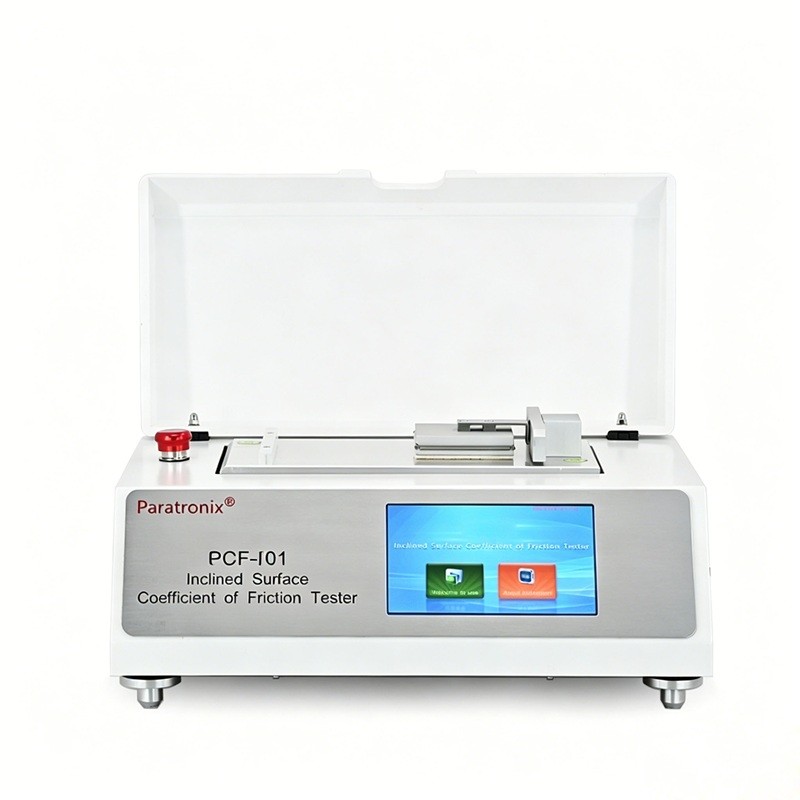
Testing instruments:PCF-I01 Inclined Surface Coefficient of Friction Tester
2.Summary of the Test Method
The test procedure outlined in ASTM D4918 is straightforward yet rigorous, designed to ensure consistent and reliable results. The key steps of the method are as follows:
1). Specimen Preparation: Two specimens of the test paper are prepared in accordance with the standard’s dimensions and sampling requirements (as referenced in ASTM D585). One specimen is clamped securely to the surface of an inclined plane, while the other is attached to a rubber-faced sled.
2). Test Setup: The rubber-faced sled, with the second paper specimen attached, is placed on the inclined plane, ensuring that the two paper specimens are in full, uniform contact.
3). Angle Measurement: The inclined plane is gradually raised at a controlled rate until the sled begins to slide. At the exact moment sliding initiates, the movement of the plane is stopped, and the angle of inclination is recorded.
4). Calculation: The coefficient of static friction is calculated as the tangent of the angle at which sliding first occurs. This relationship is derived from the fundamental physics of friction, where the static friction force equals the component of the sled’s weight parallel to the inclined plane at the point of movement initiation.
Prior to testing, all paper specimens must be conditioned in accordance with ASTM D685 to ensure that environmental factors (such as temperature and humidity) do not affect the test results. This conditioning step is critical for maintaining the reproducibility of measurements across different testing environments and laboratories.
3.Significance and Use
The coefficient of static friction is a critical property of uncoated writing and printing paper, as it directly impacts the paper’s performance in various end-use applications. Specifically, the static COF determines how easily the top or bottom sheet of a paper stack will slide across adjacent sheets—a factor that is essential for the smooth operation of sheet-fed printing presses, copiers, and other paper-handling equipment.
A minimum static coefficient of friction is required to prevent double-feeding of paper, which can cause jams, reduce production efficiency, and compromise the quality of printed materials. Conversely, an excessively high static COF can lead to difficulty in separating sheets, resulting in similar operational issues. By providing a standardized method for measuring static COF, ASTM D4918 enables paper manufacturers to ensure their products meet the performance requirements of printers, converters, and end users.
This standard also serves as a valuable quality control tool for paper producers, allowing them to monitor consistency in friction properties across production batches. For buyers and specifiers of uncoated writing and printing paper, ASTM D4918 provides a common reference point for evaluating and comparing the performance of different paper grades.
Leave A Reply
Search by Keywords