




Recent Posts
 Can a WVTR Tester Test Aluminum Foil Laminates?Oct 22, 2026
 How Do Temperature and Humidity Affect WVTR Lab Comparisons?Oct 22, 2026
 Why Do WVTR Results Differ Between Laboratories?Oct 22, 2026
 What Does a Torque Tester Measure in Bottle Cap Quality Control?Oct 22, 2026
 ASTM F1249 vs. E96: Matching Water Vapor Permeability Testers to MethodsOct 22, 2026
How Do Temperature and Humidity Affect WVTR Lab Comparisons?
Two laboratories can test the same packaging film and report different water vapor transmission rates (WVTR)—especially when temperature and humidity conditions differ. For pharmaceutical packaging and high-barrier materials, understanding those differences is essential to making meaningful comparisons. Can a WVTR tester test aluminum foil laminates? Yes, provided its measurement range and detection limit suit the laminate’s barrier performance. Temperature, humidity gradients, and specimen conditioning all influence the result, so comparing laboratory reports requires more than checking the final number.
The practical question is whether the laboratories measured the same material under equivalent conditions, with enough sensitivity to distinguish actual moisture transmission from background moisture and leakage. Until that is established, a lower reported WVTR does not necessarily mean a better barrier.
WVTR is a result under specified conditions, not a universal material constant
WVTR describes the mass of water vapor passing through a specimen per unit area per unit time, commonly expressed in g/(m²·day). The test temperature and humidity on both sides belong beside that value. Without them, the result is incomplete.
Water vapor moves in response to a difference in water vapor partial pressure. For an idealized, homogeneous film at steady state, transmission can be described approximately as permeability multiplied by the vapor-pressure difference and divided by film thickness. That relationship helps explain trends, but it is not a universal conversion formula for multilayer packaging.
In a laminate, several layers contribute resistance to transport. Adhesives, humidity-sensitive polymers, defects, and interfaces can change the response. Two structures with similar WVTR at one condition may not maintain the same ranking at another. This matters when a material qualification report becomes the reference for incoming inspection or supplier approval.
Temperature changes both the driving force and the material response
Raising the test temperature usually increases water vapor transmission through polymer packaging. Two effects are involved, and separating them makes laboratory comparisons easier to interpret.
One is the vapor-pressure driving force. Relative humidity is a percentage of the saturation vapor pressure at a given temperature. Because saturation vapor pressure rises with temperature, the same relative humidity difference at a higher temperature represents a larger water vapor partial-pressure difference.
The other effect occurs within the material. Temperature changes water sorption and molecular diffusion; diffusion generally becomes faster as temperature rises. The overall response depends on the polymer, its morphology, and the laminate construction. A temperature correction established for one structure should not automatically be applied to another.
This is why results obtained at 23°C and 38°C should not be treated as interchangeable, even if both reports specify the same nominal relative humidity. Arrhenius-type models can support temperature extrapolation over a validated range, but they require material-specific measurements and evidence that the transport mechanism remains applicable. A generic correction factor is not a sound basis for a pharmaceutical packaging acceptance decision.
Check actual chamber control as well as the setpoint. Temperature instability can affect the specimen, humidity generation, and measured signal. For low-transmission materials, small uncontrolled contributions become more consequential because the sample signal is already small.
“90% RH” does not describe the whole humidity condition
A report stating only “90% RH” leaves an important question unanswered: what was the humidity on the opposite side of the specimen? A wet side at 90% RH facing a nominally dry carrier gas is not equivalent to a wet side at 90% RH facing an environment at 50% RH.
At the same temperature on both sides, the vapor-pressure difference is proportional to the relative humidity difference. However, proportional driving forces do not guarantee proportional WVTR values. Some polymers absorb more moisture at higher humidity, changing their transport behavior. Normalizing results by the RH difference alone can therefore be misleading.
For meaningful comparison, establish the following:
- The specified humidity on both sides, including what “dry” means in the method.
- Whether the stated RH is a target setting or a verified condition.
- Which laminate surface faced the humid side.
- Whether temperature differences could create unintended local humidity changes or condensation.
Specimen orientation deserves particular attention with asymmetric laminates. It may influence moisture uptake and the time needed to stabilize, and can affect measured transmission when layer properties depend on local humidity. Record the orientation rather than assuming that reversing a multilayer specimen makes no difference.
Conditioning and equilibrium can explain an apparent laboratory disagreement
The sensor initially measures more than steady-state transport. Moisture already present in the specimen, seals, tubing, or test cell can contribute to the transient signal. A specimen transferred from humid storage may behave differently during startup from one held in a dry environment.
Conditioning should follow the applicable method or an agreed protocol. It should not be improvised simply to shorten testing. Drying a sample aggressively may alter its moisture history or affect sensitive components, while insufficient conditioning can leave a prolonged desorption signal.
Laboratories also need a common definition of equilibrium. Ending every test after a fixed number of hours does not establish that every material has reached steady state. High-barrier structures and moisture-absorbing layers may require extended stabilization. Conversely, a flat trace near the instrument background does not by itself prove that the true transmission rate has been resolved.
When results conflict, request the transmission-versus-time curves and termination criteria. A reported endpoint alone may hide continuing drift, an early transient, or a signal too close to the measurement floor for confident quantification.
Testing aluminum foil laminates requires more than a low-range specification
An intact aluminum foil layer is an exceptionally strong moisture barrier. In a real laminate, the measured result may be influenced by pinholes, flex damage, exposed edges, or leakage around the test seal. A suitable WVTR tester can evaluate the structure, but the laboratory must demonstrate that the reading represents transmission through the defined specimen area.
Start with the validated measurement range for the intended temperature, humidity, and exposed area—not just the lowest number in a brochure. Ask how the detection limit and quantification limit are established, how cell background is assessed, and what uncertainty applies near the expected result. These are related questions, not interchangeable specifications.
If transmission is below the validated reporting limit, report it as below that limit under the stated conditions. Do not turn it into “zero WVTR,” and do not rank two laminates using unresolved numerical differences below the method’s reliable capability.
Mounting also needs scrutiny. Edge ingress or seal leakage can dominate an extremely small through-film signal. Masks, sealants, and fixtures must be compatible with the method, and their contribution should be assessed. A smaller exposed area reduces the total moisture reaching the detector at a given WVTR, potentially making a low-rate measurement harder.
Sampling is another limitation. A flat coupon without a defect cannot establish the barrier performance of an entire converted package. Where creasing, forming, or sealing may damage foil, evaluate specimens representative of that processing history and consider complementary package-integrity testing. Film permeation and package leakage answer different questions.
Match the method before judging the difference
ASTM F1249 addresses water vapor transmission through plastic film and sheeting using a modulated infrared sensor. The ISO 15106 series covers instrumental approaches for determining water vapor transmission through plastic film and sheeting, while ASTM E96/E96M addresses gravimetric water vapor transmission measurements. These references do not make different methods automatically equivalent. Confirm the applicable scope, procedure, and current edition for the material and purpose.
Different detection principles, cell arrangements, and operating procedures can produce different practical measurement capabilities. Even laboratories citing the same standard may use different permitted conditions or specimen preparation details.
A useful comparison record should contain:
- Sample identity: construction, thickness, batch, sampling location, and relevant processing history.
- Exposure conditions: temperature, humidity on both sides, orientation, and exposed area.
- Procedure: method, conditioning, mounting, carrier-gas settings where applicable, and equilibrium criteria.
- Measurement quality: background checks, verification records, reporting limit, replicate results, and uncertainty where available.
Replicates help distinguish instrument variability from specimen variability. For foil laminates, scattered results may point to localized defects or handling damage rather than unstable humidity control. Investigate that possibility before averaging the readings into a single acceptance value.
Build a comparison protocol around the decision you need to make
For supplier qualification, agree on one reference condition and reporting protocol before exchanging samples. Use material from the same batch, document specimen allocation, and align conditioning and orientation. If disagreement remains, an interlaboratory comparison using shared specimens and a suitable reference material can help separate material variation from method-related differences.
For equipment selection, define the expected WVTR range and acceptance threshold first. Then assess sensitivity, environmental control, sealing arrangements, stabilization criteria, and verification procedures. Testing representative laminates is more informative than comparing nominal sensor sensitivity alone.
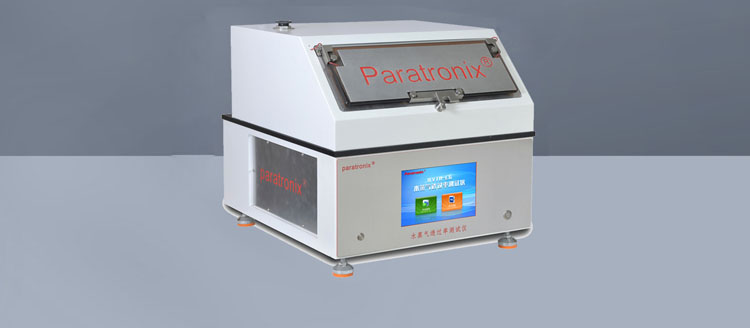
Paratronix Instruments Co., Ltd. develops and manufactures packaging testing instruments for pharmaceutical packaging, plastic packaging, and high-barrier materials, alongside broader packaging testing solutions. In discussions with an equipment supplier, provide the laminate construction, anticipated barrier level, required test conditions, and relevant method. Those details allow the proposed configuration to be assessed against the actual measurement task.
The decisive question is not which laboratory reports the lowest WVTR. It is whether both results describe the same exposure, a stabilized specimen, and a signal the method can reliably measure. Establish those points before changing a specification, rejecting a material, or attributing the difference to the tester.
Leave A Reply
Search by Keywords