




Recent Posts
 What Does a Torque Tester Measure in Bottle Cap Quality Control?Oct 22, 2026
 ASTM F1249 vs. E96: Matching Water Vapor Permeability Testers to MethodsOct 22, 2026
 Water Vapor Permeability Tester Selection for High-Barrier Packaging FilmsOct 22, 2026
 How humidity affects results from a gas transmission rate testerOct 20, 2026
 What Does a Metallic Medical Bone Screw Tester Actually Measure?Oct 20, 2026
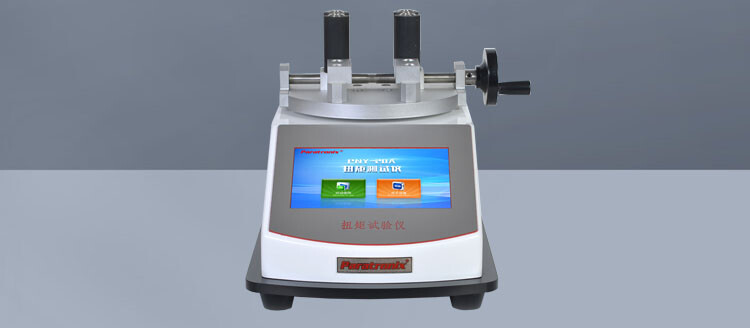


A torque tester measures the twisting effort required to tighten or open a bottle cap. In bottle cap quality control, it helps answer two practical questions: is the closure being applied consistently, and can it be opened with an acceptable amount of effort?
The result needs context. A high opening torque does not automatically mean a better seal, and a low reading does not always mean the cap was applied incorrectly. Closure materials, liner behavior, storage time, temperature, and the test method all influence the measurement. Understanding these influences makes torque data useful for diagnosing packaging problems and setting meaningful acceptance limits.
What the instrument actually measures
Torque is the turning effect of a force acting at a distance from an axis. With a bottle closure, that axis runs through the center of the cap and bottle neck. The tester senses the twisting load as the cap is tightened or loosened and displays it in units such as newton-meters, newton-centimeters, or pound-force inches.
This is different from measuring a straight pulling or pushing force. Two people can apply the same force at different distances from the cap’s center and produce different torque. That is also why cap diameter and grip design affect how easy a package feels to open, even when measured torque values are similar.
In a typical benchtop test, a fixture holds the bottle while an operator or motor rotates the cap. Depending on the instrument, the system may record only the highest torque or capture how torque changes throughout the rotation. A peak value shows the greatest resistance; a torque trace can show where that resistance occurred.
Application torque and removal torque describe different events
A torque tester may support tightening tests, opening tests, or both. The measurement must be named clearly because the values answer different questions.
Application torque influences how the closure seats and, in many designs, how the liner or sealing feature is compressed. Too little can leave the closure insufficiently seated. Too much can damage threads, distort the closure, or overload the liner. These outcomes depend on the particular bottle and cap combination.
A laboratory application test also differs from measuring a production capper directly. The capper’s setting, its operating mechanism, and the torque actually transferred to the closure are related but distinct. A removal test on a finished bottle provides evidence about the resulting package; it does not directly reveal the exact torque delivered during capping.
Why removal torque does not equal application torque
After tightening, a closure assembly changes. Plastic components can relax, liners can settle, and friction at contacting surfaces can change. Product residue, temperature exposure, and storage conditions may also affect resistance to opening.
There is therefore no universal conversion between application torque and removal torque. A relationship established for one closure system may not hold for a different resin, liner, neck finish, or storage interval. Removal torque should be interpreted against specifications developed for the actual package and measurement conditions.
A single peak can hide more than one opening event
Consider a screw cap with a tamper-evident band. The user may first overcome resistance at the seated closure, then break the band bridges, and then continue unscrewing the cap. Depending on the design, some of these events may overlap.
If the tester reports only the highest value during the entire opening operation, that peak could represent initial loosening or band breakage. Calling it simply “opening torque” leaves an important ambiguity. A change in the peak might come from the tamper band while the initial loosening resistance remains similar.
For routine checks on a straightforward screw closure, a clearly defined peak measurement may be sufficient. When investigating unexpected opening behavior, a torque-versus-time or torque-versus-angle trace, where available, can help distinguish events. The test procedure should specify which event is being evaluated and when recording begins and ends.
Child-resistant closures need additional consideration. A push-and-turn design requires coordinated axial force and rotation. A conventional torque reading alone cannot represent the complete opening action or establish child resistance. The fixture and method must accommodate the closure mechanism, with separate performance evaluation appropriate to the package.
What torque results reveal about bottle cap quality
Torque measurements are particularly useful for detecting changes in a packaging process. A stable pattern gives a reference against which a new batch, capping adjustment, or component change can be assessed.
Common patterns provide useful starting points for investigation:
- Consistently low removal readings: examine insufficient application, closure back-off, component relaxation, or changes in friction.
- Consistently high readings: examine excessive application, material sticking, product deposits, or changes in the liner and sealing surfaces.
- A wide spread between samples: examine differences between capping heads, inconsistent presentation, component variation, and the measurement technique.
- Readings that change during storage: examine elapsed time, temperature exposure, material behavior, and interaction with the contents.
These patterns suggest possible causes; they do not identify a cause by themselves. For example, a bottle that slips in the fixture or an operator who applies uneven downward pressure can produce misleading variation. Checking the measurement method should come before changing production settings.
Sampling details also matter. Keeping the filling time, capping head, component batch, and test interval with the result makes an unusual reading easier to investigate. An overall average can conceal one capping head producing a different pattern from the rest.
What a torque tester cannot confirm on its own
Torque is not a direct measurement of leak tightness, seal integrity, or barrier performance. It measures resistance to rotation. That resistance is influenced by friction and component geometry as well as the forces involved in seating the closure.
A cap can be difficult to open while a damaged liner or defective bottle finish still creates a leak path. Another closure may achieve an effective seal at a lower torque because its sealing geometry and materials behave differently. Comparing those packages only by opening torque would miss the relevant distinction.
For pharmaceutical packaging, moisture-sensitive contents, or products at risk of leakage, torque checks should sit alongside suitable package integrity and performance tests. Depending on the package, those may include leak testing, container closure integrity evaluation, or barrier testing.
Torque also does not fully predict consumer usability. Grip strength, cap diameter, surface texture, hand mobility, and opening instructions influence the experience. Instrument readings provide a repeatable mechanical measure, while usability evaluation addresses how people interact with the package.
How to obtain readings that can be compared
The most useful torque result comes from a defined procedure. If the preparation or opening technique changes between samples, the readings may describe the testing differences as much as the packages.
Control the time between capping and testing
A measurement taken immediately after capping may differ from one taken after storage. Define the elapsed time for each type of check. Immediate testing can support production adjustment; later testing helps assess the condition users may encounter. Both can be useful, provided they are recorded separately.
Hold the bottle without changing its behavior
The fixture must prevent slipping without excessively deforming the container. This is especially relevant to thin-walled plastic bottles. Position the bottle so the closure rotates around its intended axis, and use a grip that does not distort the cap. Off-center loading or excessive clamping can affect the result.
Keep rotation and downward force consistent
A sudden jerk can produce a different peak from controlled rotation. Manual testing requires a consistent technique; motorized testing can improve control when speed or repeatability is particularly important. Neither approach compensates for poor sample preparation or unsuitable fixtures.
Downward force should also be controlled where it affects the closure. It is essential for some child-resistant mechanisms and can introduce unwanted variation in ordinary screw-cap tests.
Use fresh samples for initial opening measurements
Opening and reclosing a bottle changes the closure assembly. The liner has already been compressed, contacting surfaces have moved, and a tamper band may have broken. A second opening is not a repeat of the original condition.
Use unopened specimens when measuring initial removal torque. Reclosure testing is valuable when repeated use matters, but it needs its own procedure and acceptance criteria.
Setting a useful torque range
There is no single acceptable torque value for all bottle caps. Cap size alone is insufficient to establish a specification. Thread design, liner construction, bottle stiffness, sealing mechanism, product compatibility, and intended users all influence the usable range.
Begin with the actual bottle, closure, and product combination. Component supplier guidance can provide a starting point, but the working limits should be supported by package evaluation under relevant conditions. The lower limit needs to support secure closure and required package performance. The upper limit needs to account for opening effort and the risk of component damage.
Specifications should identify whether they apply to application torque, initial removal torque, or another event. They should also state the test timing, conditioning, units, and method. A number without these details is difficult to reproduce and can lead to conflicting acceptance decisions.
During routine control, review the spread and trend as well as the average. A process can have an acceptable average while individual bottles fall outside the intended range. Changes in variability can justify investigation before the average moves substantially.
Choosing an instrument around the measurement
For basic production checks, prioritize a suitable measuring range, dependable bottle holding, clear peak capture, and straightforward calibration verification. Choosing an unnecessarily large range can make small differences harder to resolve; display resolution alone does not establish measurement accuracy.
For development or troubleshooting, controlled rotation, data export, and recording throughout the opening movement may provide more value. Confirm that the instrument and fixtures accommodate the bottle’s shape, dimensions, stiffness, and closure mechanism.
When discussing equipment with a packaging testing instrument manufacturer such as Paratronix Instruments Co., Ltd., describe the package and the opening event you need to measure. Include whether the task involves routine removal checks, controlled application, tamper band behavior, or repeated opening. Those details provide a practical basis for selecting equipment and defining a procedure that produces useful results.
Leave A Reply
Search by Keywords