




Recent Posts
 What does a lipstick breaking strength tester actually measure?Oct 16, 2026
 What Does an Adhesive Tack Tester Measure in Pressure-Sensitive Tapes?Oct 15, 2026
 Which gases can a gas transmission rate tester actually measure?Oct 14, 2026
 Should you choose a differential-pressure gas transmission rate tester?Oct 14, 2026
 Does your gas transmission rate tester meet ASTM D1434 requirements?Oct 14, 2026


1. Introduction
ASTM D3198-97 is a classic industry standard issued by ASTM International, specifying a standardized testing procedure to evaluate the application torque and removal torque performance of threaded and lug-style closures for various packaging containers. For decades, this standard has served as a core technical basis for packaging manufacturers, quality inspection institutions, and downstream enterprises in food, beverage, pharmaceutical, and daily chemical industries to verify closure assembly stability and opening usability. Although formally withdrawn in 2016, it still retains high reference value for legacy production lines, product quality archives, and historical performance verification in the packaging industry.
Container closures are critical components that ensure product sealing safety, prevent leakage, and isolate external contaminants. Inconsistent capping torque and unstable opening torque often lead to common packaging defects, including liquid leakage, loose closures during transportation, excessive opening resistance affecting consumer experience, and thread stripping. ASTM D3198-97 standardized torque testing methods effectively unify evaluation criteria for closure assembly and opening performance across the industry, eliminating errors caused by inconsistent manual and mechanical testing methods.
2. Standard Scope
Per the official provisions of ASTM D3198-97, this test method applies to all conventional threaded and lug-style closure-container matching systems. It covers the whole testing process from controlled torque application for closure assembly to quantitative measurement of closure unscrewing torque. The core testing objects include plastic, metal, and composite material closures matched with plastic, glass, and metal packaging containers.
In terms of unit specification, the standard stipulates that SI units are the official standard measurement units, while inch-pound units provided in the text are for reference only and do not serve as the basis for quality judgment. It is worth noting that this standard focuses on torque performance testing of finished closure-container assemblies and does not cover all potential safety hazards in the testing process. Users are solely responsible for formulating corresponding safety and operation specifications during actual testing.
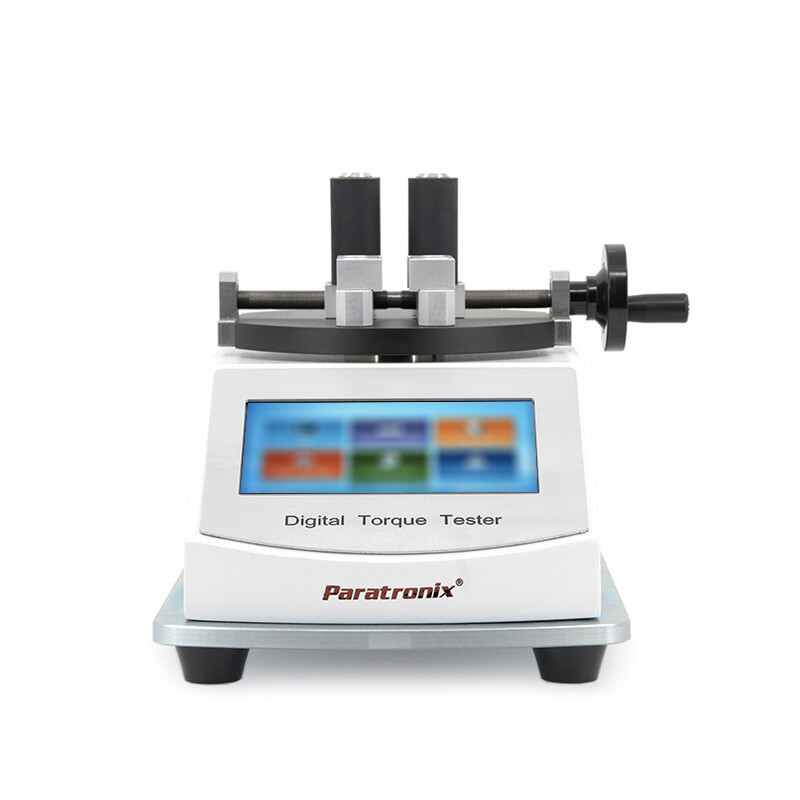
Testing equipment:PNY-20 Torque tester
3. Summary of Test Methodology
3.1 Specimen Preparation and Pre-Conditioning
The standard requires test specimens (matching closures and containers) to be representative of mass-produced products, with complete threads and lug structures, no cracks, deformation, or surface defects that may affect torque test results. Before testing, all specimens need to be placed in a standard temperature and humidity environment for pre-conditioning for a specified period to eliminate the influence of ambient temperature and humidity on the physical properties of closure materials and test data, ensuring the repeatability and accuracy of test results.
3.2 Application Torque Testing
Fix the treated container specimen on a professional torque testing device, and install the closure in the correct assembly position. Apply preset standard torque to the closure through mechanical or standardized manual operation to complete the assembly of the closure and container. Record the torque value applied during the capping process, and observe the assembly state of the closure, including whether it is fully locked, whether there is thread slipping or deviation, to evaluate the rationality of production capping torque parameters.
3.3 Removal Torque Testing
After the assembled specimen is placed stably for a specified time, keep the container fixed, and apply continuous and stable rotational force to the closure in the opening direction. Record the maximum torque value required to completely unscrew and separate the closure from the container, which is the core removal torque data. During the test, observe abnormal phenomena such as closure thread stripping, lug fracture, and seal failure, which are important indicators for judging closure structural performance.
3.4 Data Recording and Result Calculation
Complete multiple parallel tests for each group of specimens following standard requirements, record all valid torque data, and calculate the average value, maximum value, minimum value and data deviation. The test results can be used to define the optimal capping torque range of products, verify the stability of automatic capping equipment, and evaluate the opening convenience of finished packaging products.
4. Conclusion
As a classic standard in the field of packaging closure torque testing, ASTM D3198-97 has standardized the whole process of application and removal torque testing for threaded and lug-style closures, filled the gap of unified industry evaluation criteria in the early stage, and laid a solid foundation for the standardized development of packaging quality control. Even after its withdrawal, its standardized test logic, specimen processing specifications and data evaluation methods still have important guiding significance for modern packaging torque performance testing. It remains an important archival technical document for the packaging industry to summarize historical processes and optimize current quality control systems.
Leave A Reply
Search by Keywords