




Recent Posts
 Can a WVTR Tester Test Aluminum Foil Laminates?Oct 22, 2026
 How Do Temperature and Humidity Affect WVTR Lab Comparisons?Oct 22, 2026
 Why Do WVTR Results Differ Between Laboratories?Oct 22, 2026
 What Does a Torque Tester Measure in Bottle Cap Quality Control?Oct 22, 2026
 ASTM F1249 vs. E96: Matching Water Vapor Permeability Testers to MethodsOct 22, 2026
Official Technical Guide for Website Release
Abstract
ASTM F1249-25, formally titled Standard Test Method for Water Vapor Transmission Rate Through Plastic Film and Sheeting Using a Modulated Infrared Sensor, is a globally recognized, referee-grade standard for quantifying moisture barrier performance of flexible polymer materials. This article systematically elaborates the test principle, applicable scope, standardized operating workflow, core test indicators, industrial application scenarios, technical advantages over traditional gravimetric methods, and standardized data interpretation compliant with ASTM F1249, serving as a professional reference for R&D, incoming quality control, third-party testing and material certification of packaging, electronic, pharmaceutical and food industries.
1. Overview & Standard Scope
1.1 Standard Definition & Version
ASTM F1249 is developed by ASTM Committee F02 on Flexible Barrier Materials; the latest valid edition is F1249-25, replacing F1249-20. It specifies a gas-sweeping modulated infrared detection technique to measure water vapor permeation through thin flexible substrates under precisely controlled temperature and relative humidity gradients.
1.2 Applicable Materials
This method covers single-layer, multi-layer, coated, metallized polymer films and sheets with maximum thickness up to 3 mm, including:
Synthetic polymers: PE, PP, PET, PA, PVC, EVOH, PVDC, PLA biodegradable films
Composite laminates: Aluminum foil composites, vacuum metallized films, coated barrier sheets
Natural flexible barrier substrates, modified bio-based polymer membranes
Excluded: Rigid thick plastic blocks, porous foam without continuous barrier layers, non-sealable hard specimens.
1.3 Measurable Core Parameters
Per ASTM F1249 requirements, three key barrier indicators can be calculated from steady-state infrared detection data:
Water Vapor Transmission Rate (WVTR): Primary output, unit: g/(m²·24h), representing mass of water vapor passing through per unit area per day
Water Vapor Permeance: WVTR divided by water vapor partial pressure difference across the sample, unit: g/(m²·s·Pa)
Water Vapor Permeability Coefficient: Only valid for homogeneous single-layer materials, product of permeance and sample thickness, unit: g·mm/(m²·24h·kPa)
Note: Permeance and permeability coefficients shall be quoted cautiously for multi-layer or coated films, as thickness-permeation linear correlation cannot be guaranteed for heterogeneous structures.
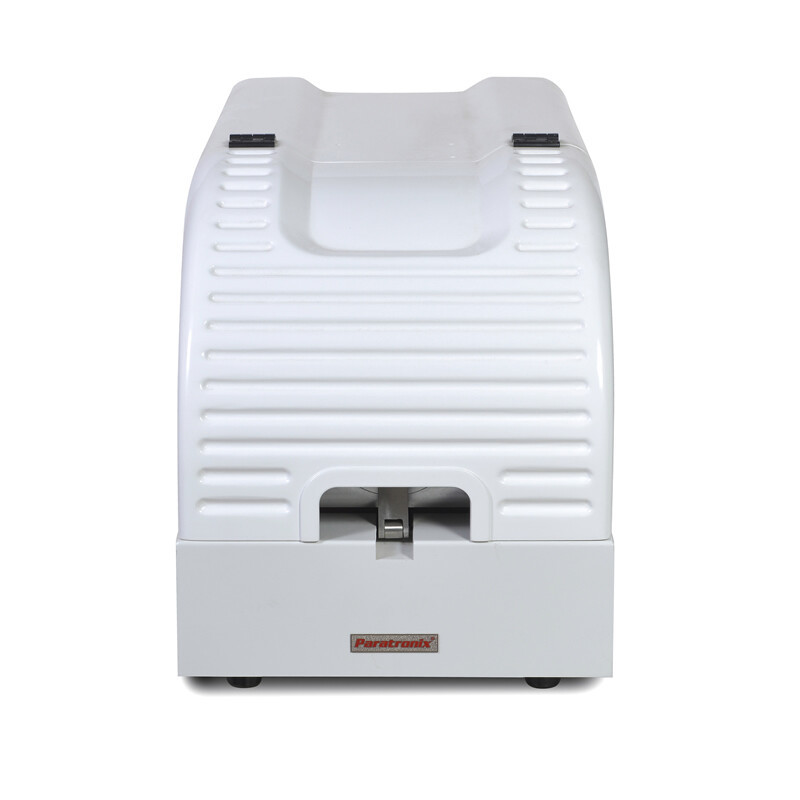
Testing equipment:WVTR-E3 Water Vapor Permeability Tester (Infrared method)
2. Core Testing Principle of Modulated Infrared Sensor
ASTM F1249 adopts a dual-chamber differential humidity cell combined with patented modulated infrared water vapor sensor, the full physical mechanism is as follows:
1.A flat sample is hermetically sealed between two independent temperature-controlled chambers to form a complete partition.
2.The upstream (supply) chamber maintains constant high relative humidity (typical standard condition: 38°C, 90% RH) to generate stable water vapor partial pressure gradient across the specimen.
3.Dry, purified nitrogen carrier gas continuously sweeps the downstream (detection) chamber at a fixed volumetric flow rate.
4.Water vapor diffuses through the film matrix driven by partial pressure difference, and is fully carried by dry nitrogen into the modulated infrared detector.
5.Water molecules selectively absorb infrared light at a specific characteristic wavelength; the modulated IR sensor converts light absorption intensity into real-time water vapor concentration signals.
6.The system records concentration changes continuously until steady-state permeation equilibrium is achieved. Combined with carrier gas flow rate, effective test area and environmental parameters, the instrument automatically computes standardized WVTR values compliant with ASTM F1249 algorithms.
3. Standardized Test Procedure (ASTM F1249 Compliant)
Step 1 Sample Preparation & Pre-Conditioning
Cut specimens to match instrument test cell size, remove surface dust, fingerprints and residual volatile solvents; avoid scratches, pinholes or creases that cause data deviation.
Pre-condition samples under agreed temperature and humidity for a minimum of 24 h to eliminate internal residual moisture, per ASTM conditioning requirements.
Record actual sample thickness at 3–5 random positions for permeance coefficient calculation.
Step 2 Instrument Calibration & Setup
Purify nitrogen carrier gas to dew point ≤ -60°C to eliminate background moisture interference.
Calibrate modulated infrared sensor with certified water vapor reference standards as specified in F1249 Annex A1.
Set target test temperature, upstream RH and carrier gas flow rate according to product specification or industrial standard contract. Common reference condition: 38 °C / 90 % RH (primary ASTM standard condition).
Step 3 Specimen Sealing & Stabilization
Mount the conditioned sample into the diffusion cell with complete peripheral sealing to prevent bypass leakage (leakage blank test is mandatory before formal testing). Purge both chambers for 30–120 min to stabilize baseline moisture signal.
Step 4 Steady-State Detection & Data Acquisition
The instrument continuously monitors IR moisture readings. ASTM F1249 defines steady state as three consecutive 30-min reading groups with deviation ≤ 2%. After equilibrium is confirmed, the system captures average WVTR, standard deviation and curve data for report output.
Step 5 Post-Test Validation
Run blank leakage test after each batch to verify no seal failure; archive full raw signal curves, environmental logs and calibration records for traceability, meeting referee test data retention requirements.
ASTM F1249 modulated infrared WVTR testing remains the gold standard for flexible barrier material moisture permeation characterization, combining ultra-high detection sensitivity, fast testing cycles, full automation and authoritative arbitration validity. For enterprises involved in packaging material development, quality control and cross-border product supply, implementing standardized ASTM F1249 infrared WVTR testing delivers accurate, repeatable barrier performance data to optimize material selection, extend product shelf life and meet global industry regulatory and customer certification requirements.
Leave A Reply
Search by Keywords