




Recent Posts
 Comparing Gravimetric, Coulometric, and Modulated IR WVTR TestersSep 11, 2026
 Choosing the Right Water Vapor Transmission Rate Tester: Pharmaceutical Packaging LabsSep 11, 2026
 Which ASTM Methods Apply to Sauce Packet Pressure Resistance Burst and Creep Tests?Sep 08, 2026
 How Can Packaging Film Manufacturers Use a Friction Coefficient Stripping Tester?Sep 04, 2026
 What Is a Friction Coefficient Stripping Tester and Where Is It Used?Sep 04, 2026
1. Standard Overview
ASTM D4918 is a classic ASTM international standard specifying a standardized inclined plane test method to determine the static friction coefficient (SCOF) of uncoated writing and printing paper when sliding against identical paper substrates. Officially released and updated as ASTM D4918-97 (2007 reapproval), this standard was formally withdrawn by ASTM International in 2010 but remains universally adopted as a core industry benchmark for paper surface friction characterization across global pulp, paper and printing manufacturing sectors.
Different from horizontal pull-based friction test standards, ASTM D4918 adopts a pure mechanical inclined plane principle with simple structure, high test repeatability and low environment interference, exclusively customized for uncoated offset paper, copy paper, writing paper and commercial printing base paper, eliminating test deviation caused by coating fillers and surface coating layers.
2. Core Scope & Application Boundary
2.1 Applicable Materials
This standard covers all types of uncoated writing paper and commercial printing paper without surface pigment coating, adhesive coating or functional coating, including office copy paper, offset body paper, notebook writing paper, newsprint base paper and cultural uncoated paper. It is not applicable to coated art paper, cardboard, tissue paper or functional treated specialty paper.
2.2 Test Object Definition
The test measures static friction coefficient between paper-to-paper contact surfaces (same paper material double-sided contact), rather than paper-to-metal or paper-to-rubber friction parameters, which matches actual stacking and transportation scenarios of finished paper reels and sheeted paper stacks.
2.3 Exclusion Note
This method only detects static friction properties, excluding dynamic friction coefficient testing; all precision data and test tolerances in the standard are verified based on conventional gram-weight uncoated cultural printing paper.
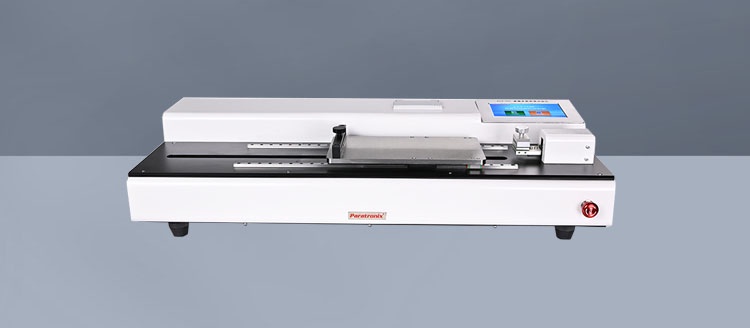
Testing equipment:PCF-I01 Inclined Surface Coefficient of Friction Tester
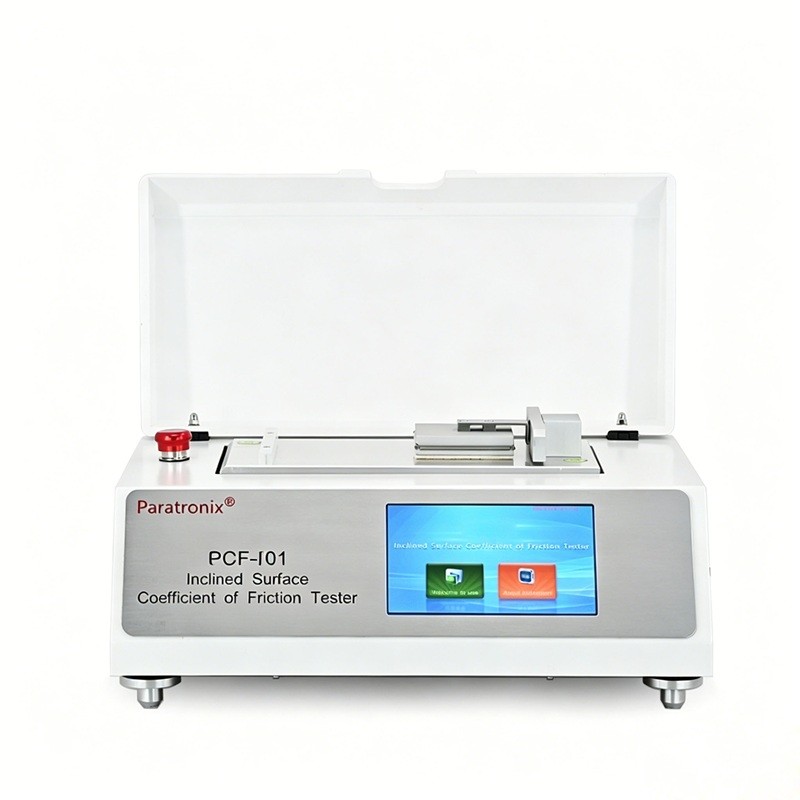
3. Inclined Plane Test Principle of ASTM D4918
The core test theory complies with classical mechanical static friction mechanics, realizing non-destructive, stress-stable paper friction detection:
A fixed paper specimen is attached to the inclined test platform, while a matched paper slider (covered with identical uncoated paper sample) is placed flat on the fixed specimen surface. The test platform rises at a constant, controlled tilting speed gradually to increase the inclined angle. At the critical angle where the paper slider generates initial sliding displacement, record the inclined tilt angle (θ). The static friction coefficient is calculated via the fixed formula: COF = tanθ.
Compared with horizontal friction testers, the inclined plane method removes external traction force error, avoids paper surface tensile deformation during pulling, and retains original paper surface fiber and roughness status to obtain authentic raw friction data of uncoated paper.
4. Why Choose Our Standard-Compliant ASTM D4918 Testing Service
As a professional paper material testing solution provider, our company delivers full-set ASTM D4918 compliant testing and technical support for global paper manufacturers, printing factories and raw material suppliers:
- Fully calibrated inclined plane friction test instruments 100% matching ASTM D4918 dimensional and speed specifications;
- ISO 17025 accredited laboratory with standard constant temperature and humidity paper conditioning workshop;
- Professional technical team sorts out standard difference between withdrawn ASTM D4918 and updated TAPPI alternative standards;
- Issue international recognized test reports for product quality audit, factory inspection and cross-border customs clearance;
- Customize paper friction performance process optimization suggestions for uncoated writing and printing paper production lines.
Leave A Reply
Search by Keywords