




Recent Posts
 Which WVTR Tester Is Suitable for Pharmaceutical Packaging?Oct 26, 2026
 Heat Seal Tester vs Hot Tack Tester: Which ASTM Standards Apply?Oct 24, 2026
 Gas Permeability Testing: Differential or Equal Pressure?Oct 24, 2026
 ISO 9187 and Ampoule Break Force Testing: Which Requirements Apply?Oct 24, 2026
 What does a syringe needle puncture tester measure during insertion?Oct 24, 2026


Why “Accurate” Isn’t Enough—What Pharma Labs Actually Test For
If you’ve ever sat through a vendor demo where the presenter opened with “Our Water Vapor Transmission Rate Tester delivers ±0.5% accuracy,” pause—and ask what that number even means in your lab. Accuracy claims are rarely the bottleneck. What stalls method transfer, delays stability batches, or triggers audit questions is repeatability across shifts, robustness against ambient humidity swings, and how well the system handles real-world pharma samples: foil-laminated blisters with micro-creases, cold-formed aluminum trays with edge lift, or multi-layer pouches sealed under variable pressure.
At Paratronix Instruments, we don’t build general-purpose WVTR testers and then “adapt” them for pharma. We start from the QA workflow—not the spec sheet. That means designing around three non-negotiable anchors: how the instrument behaves when your lab hits 65% RH at noon in July, how easily it integrates into your existing LIMS or electronic lab notebook, and whether calibration stays stable between quarterly audits without needing daily revalidation.
The Three Parameters That Separate Lab-Ready From Lab-Fragile
Most procurement comparisons fixate on resolution (e.g., 0.001 g/m²/day) or test range. Useful—but secondary. Here’s what actually moves the needle in day-to-day use:
1. Temperature & Humidity Control Stability—Not Just Setpoint
ASTM F1249 and ISO 15106-3 require precise control of both sides of the test cell: dry side ≤ 0.1% RH, humid side typically 90% RH at 37.8°C. But specs often quote “±0.3°C” or “±1% RH”—without saying over what volume, or how quickly recovery happens after door opening. In practice, labs with high throughput open test chambers 8–12 times per shift. If humidity recovery takes 15 minutes, you’re losing 2 hours of usable test time per day. Look instead for documented recovery time at full chamber load—and verify it’s measured with traceable external probes, not internal sensor readings alone.
2. Sample Handling Tolerance—Especially for Foils and Laminates
Pharma packaging isn’t flat film. It’s embossed blister foil with 25-µm aluminum layers, sometimes backed by PET or paperboard. A rigid clamping mechanism that works fine for 100-µm PE film can compress or distort thin foils, creating false seal paths or localized stress points. We’ve seen cases where identical foil lots gave 12% higher WVTR results simply because the tester’s clamp pressure wasn’t adjustable—or wasn’t calibrated to match actual blister cavity geometry. Ask vendors: Does your system offer variable clamping force? Can it accommodate curved or pre-formed samples without custom fixtures?
3. Data Traceability That Survives an FDA Inspection
“Audit-ready” isn’t about generating PDF reports. It’s about unbroken chains: Who initiated the test? Which calibration standard was used—and when was its certificate last renewed? Was the chamber purged before sealing? Did the system log ambient lab conditions alongside test data? If your current tester timestamps only the start and end, but doesn’t record purge gas flow rate or dew point during equilibration, you’ll spend hours reconstructing context during a 483 inspection. At Paratronix, every test run captures 32+ metadata fields—including operator ID tied to network login, real-time sensor drift alerts, and automatic certificate linkage. Not because it’s flashy—but because it’s the difference between a 20-minute response to an auditor’s question and a CAPA.
Automation Isn’t About Speed—It’s About Consistency
Don’t mistake robotic sample loading for true automation. Some systems automate placement—but still require manual verification of seal integrity, manual entry of lot numbers, and manual export to Excel before upload to your stability database. That’s not automation; it’s choreography. True lab-grade automation means the system validates seal pressure *before* starting the test, auto-rejects runs where baseline drift exceeds 5% over 30 minutes, and pushes clean, structured JSON directly into your LIMS—no human copy-paste. If your team spends more than 90 seconds per sample on prep, validation, or data handoff, the bottleneck isn’t personnel—it’s the tool.
A Note on Standards Compliance—Beyond the Checkbox
Yes, your Water Vapor Transmission Rate Tester must comply with ASTM F1249, ISO 15106-3, and possibly USP <671>. But compliance isn’t binary. Two instruments may both “meet ASTM F1249”—yet one uses modulated IR detection with NIST-traceable reference cells, while the other relies on gravimetric weighing with manual desiccant replacement. The first gives continuous real-time curves; the second gives a single endpoint value, vulnerable to handling error or desiccant saturation. Ask for the *method principle*, not just the standard number. And confirm whether the system’s uncertainty budget includes contributions from temperature gradients, sensor hysteresis, and purge gas purity—details most vendors omit unless asked directly.
What to Do Before You Sign the PO
Run one real test—not a demo. Bring in three samples you routinely test: a high-barrier cold-form foil, a medium-barrier laminated pouch, and a low-barrier HDPE bottle cap. Use your own operators, on your own bench, with your own ambient conditions. Time how long it takes to go from unboxing a new sample to having validated, LIMS-ready data. If it’s over 4 minutes, dig deeper. Also request the instrument’s last 3 calibration certificates—and check whether they include uncertainty statements for *all* critical sensors (not just the main detector).
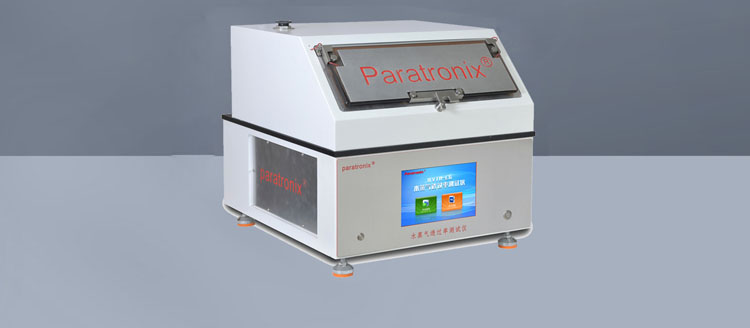
At Paratronix, we design Water Vapor Transmission Rate Tester systems knowing that pharma labs don’t buy instruments—they buy confidence in their stability data. That confidence comes not from brochure specs, but from how the system holds up when the HVAC fluctuates, when the night shift runs the same method, and when an inspector asks, “How do you know this result is traceable?” Choose accordingly.
Leave A Reply
Search by Keywords