




Recent Posts
 ASTM D642 and ISO 12048: Requirements for Package Compression TestingOct 12, 2026
 What Does a Paper Thickness Tester Measure, and Why Does It Matter in QC?Oct 12, 2026
 How test speed affects lipstick breaking strength resultsOct 10, 2026
 Choosing a Water Vapor Transmission Rate Tester for flexible filmsOct 10, 2026
 How to select a friction peel tester for flexible packaging filmsOct 09, 2026
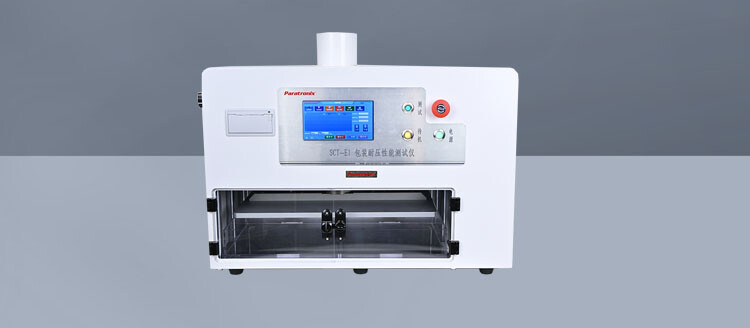


ASTM D642 and ISO 12048 provide methods for measuring packaging performance under compressive loading, but neither establishes a universal minimum strength for every package. A valid assessment requires more than a peak-force reading: the package configuration, conditioning, loading arrangement, test endpoint, and acceptance criteria must all be defined. A machine advertised as supporting both standards does not, by itself, demonstrate that a particular test complies with either one.
The principal distinction is scope. ASTM D642 addresses the compressive resistance of shipping containers, components, and unit loads. ISO 12048 addresses compression and stacking tests on complete, filled transport packages using a compression tester. Their capabilities overlap, but results should not be treated as interchangeable unless the relevant procedures and test conditions have been compared.
What the standards establish—and what they leave to the specification
ASTM D642, Standard Test Method for Determining Compressive Resistance of Shipping Containers, Components, and Unit Loads, provides a framework for evaluating resistance to externally applied compressive forces. Its scope accommodates different specimen types and loading directions, making it relevant to container development, component assessment, and unit-load evaluation.
ISO 12048, Packaging—Complete, filled transport packages—Compression and stacking tests using a compression tester, focuses on the complete package. It covers evaluating compressive strength and assessing performance under a specified stacking load. The distinction between increasing the load toward a defined endpoint and maintaining a load for a specified period is important when selecting equipment and interpreting results.
Neither standard certifies packaging as suitable for every distribution route. Nor does either provide a single pass/fail force that applies across package sizes, contents, warehouse conditions, and stacking arrangements. Acceptance limits must come from an applicable product specification, customer requirement, distribution-test protocol, or justified engineering assessment.
The exact edition matters. A test specification should identify the standard designation and edition, rather than referring only to “ASTM compression testing” or “ISO-compliant testing.” The applicable published text remains the controlling source for mandatory apparatus tolerances, procedures, and reporting requirements.
Choose the method around the question being answered
A compression-to-failure test answers a different question from a sustained-load test. Increasing compression can establish maximum resistance, characterize deformation, or identify the load at which a defined failure occurs. Holding a specified force evaluates whether the package maintains acceptable performance over a stated duration.
This difference becomes significant for materials with time-dependent behavior. A corrugated package that resists a relatively short compression test may deform progressively under a lower sustained load. Plastic packaging can also exhibit creep. Peak compression strength therefore cannot be converted directly into a guaranteed warehouse stacking duration.
Where a contract permits either standard, method selection still needs technical justification. Empty-container testing and complete, filled-package testing are not equivalent: contents may reinforce the package, transfer load through internal supports, or suffer damage before the outer container collapses.
Specimen preparation determines what the result represents
The specimen must represent the configuration under evaluation. Relevant details include container dimensions, material construction, closures, internal partitions, cushioning, product arrangement, and filling mass. For a complete-package assessment, omitting inserts or replacing the product with a mechanically different substitute can change the load path.
A dummy product should not be considered representative merely because its mass matches the real contents. Its stiffness, geometry, contact surfaces, and position can affect compression behavior. Any substitution needs a documented basis and must be permitted by the applicable procedure.
Orientation also matters. Top-to-bottom compression may be appropriate for a vertically stacked carton, while another orientation may be relevant to the specified handling arrangement. The loaded faces and specimen position should be stated explicitly. A result described only as “box compression strength” leaves an important part of the test undefined.
Conditioning is particularly important for moisture-sensitive packaging. Temperature and relative humidity can affect corrugated-board stiffness and compression resistance. Specimens should be conditioned under the atmosphere required by the applicable specification, with conditioning and test environments recorded. ASTM D4332 and ISO 2233 provide relevant conditioning frameworks where referenced or otherwise specified.
Conditioning and testing should be treated as a connected process. Moving a conditioned specimen into a substantially different laboratory environment can change its state before loading. Where the method permits testing outside the conditioning atmosphere, the transfer and exposure conditions still need control and documentation.
Platen configuration is part of the method
A compression tester applies load through opposing platens, but the way those platens behave affects the result. Platen size, rigidity, flatness, alignment, and mounting must satisfy the selected method and accommodate the specimen. A force rating alone does not establish suitability.
Fixed and swiveling platen arrangements respond differently to a package whose upper surface is uneven or whose walls begin to collapse asymmetrically. A swiveling platen can accommodate angular movement; a fixed arrangement constrains that movement differently. The permitted configuration must be checked against the selected procedure, and the configuration used should be recorded.
The loaded surfaces must be supported as required without unintended overhang or contact with unrelated machine structures. Testing a package larger than the usable platen area can create localized loading instead of the intended compression condition. Similarly, a frame or platen that deflects substantially under load can alter force distribution.
Flat-platen compression is not a complete simulation of every warehouse interface. Pallet deck gaps, offset stacking, overhang, and uneven support can change package performance. If these conditions are introduced into a test, the arrangement and its relationship to the standard method must be made explicit rather than presented as an unqualified standard result.
Loading control and measurement need separate evaluation
A Package Compressive Resistance Tester should be evaluated against the intended test modes, not simply its maximum capacity. A machine capable of controlled platen movement may perform a compression-to-failure test but lack the force-control performance needed to maintain a stacking load as the specimen deforms.
For increasing-load tests, the machine must achieve the loading rate required by the applicable method. The selected rate should come from the governing standard and edition; one generic laboratory speed should not be assumed valid for both ASTM D642 and ISO 12048.
For sustained-load work, ask how the controller establishes and maintains force. Overshoot during initial loading can damage the specimen before the intended holding period begins. During the hold, insufficient compensation for creep can allow force to drift. Controller behavior, allowable variation, timing, and data recording therefore need evaluation alongside nominal load capacity.
Force measurement must be suitable over the actual working range. A high-capacity load cell may provide inadequate performance at the lower forces relevant to a small package. Resolution, accuracy, repeatability, and calibration coverage are separate characteristics; a display showing many decimal places does not establish accurate measurement.
Displacement measurement needs similar scrutiny. Crosshead travel can include frame compliance, fixture movement, and initial seating as well as package deformation. If deformation is an acceptance criterion, the measurement definition must be clear. Machine travel should not automatically be described as direct package deformation.
Sampling and recording must capture the relevant behavior. An inadequately recorded force–displacement curve can miss a brief maximum or obscure successive collapse events. For a sustained-load test, the system should retain evidence of force stability and deformation over the holding period, rather than save only an initial and final reading.
Define failure before starting the test
“Test until failure” is incomplete unless failure has an operational definition. Possible endpoints include maximum force, a specified deformation, structural collapse, or another criterion required by the governing procedure. These endpoints are not automatically equivalent.
A package can lose protective function before reaching its highest measured force. Closure separation, damage to contents, or excessive deformation may be unacceptable even while the container continues carrying load. Conversely, a local crease may not constitute failure under the agreed specification. Observations should distinguish measured endpoints from broader judgments about package suitability.
Preload and the displacement reference also require attention. The position at which deformation is set to zero affects reported displacement, especially for uneven or initially compliant surfaces. Seating procedures and any initial load should follow the applicable method and remain consistent between comparative tests.
Replicate specimens are necessary when the specification calls for them and valuable when evaluating variability. Differences in board construction, converting, adhesive application, and assembly can produce different results between nominally identical packages. Sample quantity and statistical acceptance rules should follow the governing specification, not an unsupported universal rule.
Relate compression results to stacking without overstating them
The static weight above a bottom package provides a starting point for defining a stacking load. In a simple vertical stack of identical packages, that load is based on the gross mass of the packages above it multiplied by gravitational acceleration. However, this calculation does not establish a sufficient laboratory acceptance force by itself.
Stacking duration, moisture exposure, load sharing, alignment, pallet support, and handling history influence the relationship between laboratory resistance and service performance. Any safety factor or adjustment must have a stated engineering or contractual basis. Neither standard should be represented as supplying a universal multiplier for every distribution environment.
Unit loads require particular care. Stretch wrap, interlocking patterns, neighboring packages, and pallet stiffness can redistribute force. A single-package compression result does not fully characterize a palletized load, even when package dimensions and gross mass are known.
Compression testing also does not replace vibration, shock, or drop testing where those hazards are relevant. Prior mechanical exposure can affect subsequent compression resistance. If compression follows another test, the sequence and specimen history belong in the test definition and report.
Evidence needed for a defensible compliance claim
A useful test report allows another laboratory to understand the conditions that produced the result. Alongside the information required by the selected standard, it should clearly identify:
- The standard designation, edition, and any deviations.
- The specimen configuration, contents, closures, orientation, and preparation.
- Conditioning conditions and the environment during testing.
- The tester, platen arrangement, and relevant calibration status.
- The loading rate or specified load and holding duration.
- The endpoint, force and deformation results, and observed damage.
- The specimen count, individual results, and applicable acceptance criteria.
Equipment documentation should support these records. Calibration evidence needs to cover the relevant force range, while displacement, speed, and load-holding performance need verification appropriate to their role in the method. Calibration establishes measurement performance; it does not prove that specimen preparation or test execution followed the standard.
When evaluating a supplier’s claim that an instrument supports ASTM D642 and ISO 12048, request evidence tied to the intended application: usable specimen dimensions, permitted platen arrangements, loading controls, measurement tolerances, and reporting functions. A generic “standards compliant” statement is weaker than a documented comparison between the required procedure and the machine’s demonstrated capabilities.
The defensible outcome is a traceable test result linked to a defined package specification. Standardized compression testing can establish how a package behaves under controlled loading, but suitability for storage and distribution depends on whether those conditions—and the acceptance criteria—represent the application being approved.
Leave A Reply
Search by Keywords