




Recent Posts
 Key Specifications to Compare When Selecting a Lipstick Break Force TesterOct 08, 2026
 What Does a Lipstick Break Force Tester Measure in Quality Control?Oct 08, 2026
 Validation Records and Test Standards for Artificial Skin Puncture TestingSep 24, 2026
 Force Tester or Universal Testing Machine for Artificial Skin Puncture Tests?Sep 24, 2026
 What Does an Artificial Skin Puncture Force Tester Measure in Needle Testing?Sep 24, 2026

1. Introduction
In the packaging and flexible materials industry, the integrity of a heatseal is paramount. It directly influences product protection, shelf life, safety, and overall performance. The ability to consistently create and evaluate strong, reliable seals is therefore a critical quality control parameter. ASTM F2029 - 08, titled "Standard Practices for Making Heatseals for Determination of Heatsealability of Flexible Webs as Measured by Seal Strength," provides a foundational methodology for this essential task. This standard does not prescribe pass/fail criteria but establishes a controlled, reproducible procedure for creating heatseal specimens that are subsequently tested for strength (typically using a test method like ASTM F88 for seal strength measurement). Its primary objective is to enable a fair comparison of the heatsealability of different flexible webs or the performance of sealing equipment under consistent laboratory conditions.
2. Scope and Significance
ASTM F2029-08 applies to a wide range of flexible webs, including single-layer plastic films, coated papers, laminates, and other flexible packaging materials. Its practices are designed to isolate the inherent sealability of the material(s) by standardizing the sealing process itself. This is significant because real-world sealing on production lines can be influenced by numerous variables (e.g., machine dynamics, web handling). This laboratory practice removes many of those variables, allowing material scientists, packaging engineers, and quality assurance professionals to:
Compare Materials: Evaluate and rank different films or laminates for their intrinsic sealing performance.
Optimize Parameters: Determine the optimal combination of sealing parameters (temperature, time, pressure) for a given material.
Quality Assurance: Monitor the consistency of incoming materials or finished products.
Troubleshoot: Investigate seal failures by benchmarking against a controlled laboratory seal.
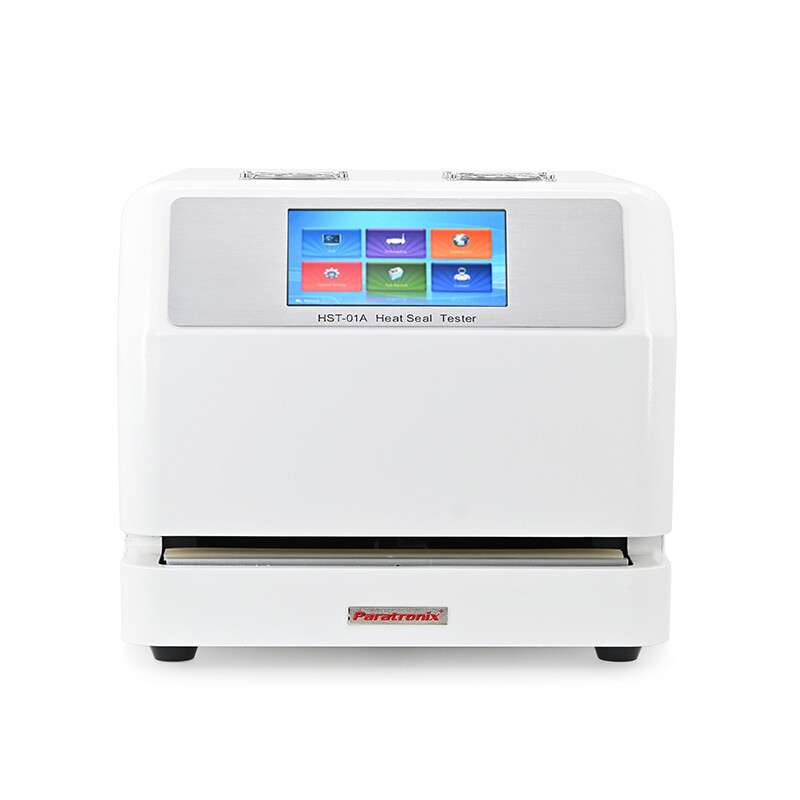
Testing equipment:HST-01A Hot sealing tester
3. Key Practices and Equipment
The standard meticulously outlines the equipment and procedures required to create standardized heatseals.
Heat Seal Apparatus: The practice requires a laboratory-grade heat seal device capable of precise, independent control of the three critical parameters:
Temperature: The temperature of the sealing jaws must be uniform and accurately controllable, typically verified using surface pyrometers or thermal tapes.
Dwell Time: The time the jaws are held closed under pressure must be precisely timed, commonly ranging from 0.25 to 5.0 seconds.
Pressure: The applied pressure must be uniform across the seal face and consistently adjustable, often expressed in psi or kPa.
Jaw Design: The standard describes different jaw face configurations (e.g., flat, serrated, wire) and recommends a smooth, flat face for general purpose evaluation to ensure even pressure distribution and a well-defined seal area.
Specimen Preparation: Test specimens are cut from the web material. The standard emphasizes the importance of sealing "face-to-face" or "face-to-back" as intended for the material and avoiding contamination of the sealing surfaces.
Conditioning: Both the material and the sealed specimens must be conditioned in a standard atmosphere (e.g., 23±2°C and 50±5% RH per ASTM D618) before and after sealing to minimize the effects of ambient moisture and temperature on test results.
4. Interpretation and Reporting
The outcome of following ASTM F2029-08 is not a single number but a characterization of the material's sealing behavior. The seal strength data, when plotted, allows users to identify:
Onset of Sealing: The temperature where a measurable seal first forms.
Optimal Sealing Range: The plateau of maximum seal strength.
Over-Sealing/Degradation: The temperature where strength may drop due to material thinning or degradation.
A comprehensive report, as suggested by the standard, includes full identification of the material tested, detailed description of the heat-sealing apparatus and its settings, conditioning parameters, the specific seal strength test method used, and all individual and averaged results.
5. Conclusion
ASTM F2029-08 is an indispensable tool in the science of flexible packaging. By providing a rigorous, standardized framework for creating laboratory heatseals, it transforms sealability from a subjective assessment into a quantifiable, comparable material property. The practices empower stakeholders across the supply chain to make informed decisions about material selection, process setup, and quality control, ultimately contributing to the production of safer, more reliable, and higher-performance packaged goods.
Leave A Reply
Search by Keywords