




Recent Posts
 Can an ASTM E96 WVTR tester measure coated paper?Nov 14, 2026
 How does an ASTM E96 water vapor transmission rate tester work?Nov 14, 2026
 What does ISO 15106-3 require of a WVTR test method?Nov 14, 2026
 What does ASTM F1249 require for medical packaging WVTR testing?Nov 13, 2026
 Infrared vs Gravimetric WVTR Testing for Food PackagingNov 13, 2026
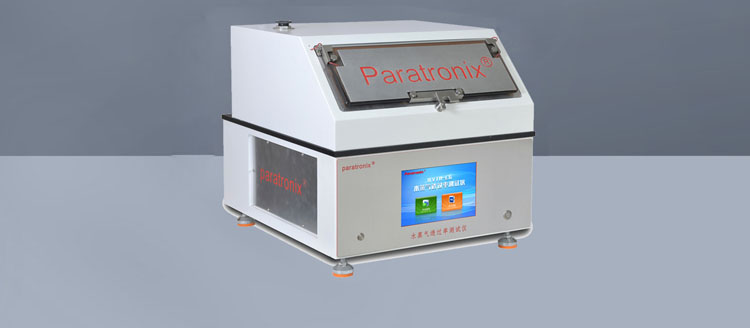
Yes, an ASTM E96 water vapor transmission rate tester can measure coated paper when the material and test conditions are suitable for the standard’s gravimetric method. For project managers responsible for packaging performance, understanding how coating integrity, humidity, temperature, and specimen preparation affect results is essential to selecting a reliable test method. The more difficult question is not whether a coated sheet can be mounted on a test dish, but whether the resulting number will support the decision the project needs to make.
Coated paper is not a single material category in performance terms. A lightly coated printing paper, a dispersion-barrier paper and a paper laminated with a polymer layer may behave quite differently when exposed to moisture. Before specifying a test, identify the functional layer, the direction in which moisture will move in the intended package, and whether the material will be converted after testing.
What the gravimetric test can tell you
ASTM E96/E96M describes water vapor transmission testing by gravimetric methods. A specimen is sealed over the opening of a dish that creates a humidity difference across the material. The dish is placed in a controlled environment and weighed over time. Once an appropriate steady rate of mass change has been established, the water vapor transmission rate, or WVTR, is calculated using the exposed area and elapsed time.
Two commonly discussed arrangements are the desiccant, or dry-cup, method and the water, or wet-cup, method. They create different moisture conditions around the specimen. The choice is not merely a matter of laboratory preference: coated paper can respond to humidity, and a result from one arrangement should not automatically be treated as interchangeable with a result from the other.
WVTR is typically reported as mass of water vapor transmitted per unit area per unit time, often in g/m²/day. It is a property of the tested structure under stated conditions, not a universal value that applies at every temperature and relative humidity. For a multilayer paper, it represents the performance of the specimen as a whole; it does not isolate the contribution of the coating from that of the paper substrate.
Start with the moisture challenge, not the instrument
A useful test plan begins with the package’s expected exposure. A dry product in a humid distribution environment presents a different question from a moisture-containing product packed in a paper-based structure. Consider which side of the material will face the higher humidity, whether the package is exposed continuously or intermittently, and whether temperature changes are likely during storage or transport.
Then check the applicable edition of ASTM E96/E96M and any customer specification. The selected procedure, test atmosphere, specimen conditioning and reporting requirements need to be agreed before samples are submitted. If a customer asks for an “ASTM E96 value” without naming the conditions, ask for the missing details. Two technically valid results can be unsuitable for direct comparison if the humidity gradient, temperature, orientation or method differs.
Paper adds a further complication: it can absorb and release moisture as it approaches equilibrium. Early changes in dish mass may therefore include effects beyond steady vapor transmission through the sheet. Conditioning and sufficient observation time matter, particularly when comparing materials with different paper weights or coating constructions. A short test may produce a number quickly while giving a poor basis for a material decision.
Coating orientation and specimen preparation can change the result
For a single-side-coated paper, record which face is exposed to each side of the humidity gradient. The paper and coating may respond differently to moisture, and the coating may be more vulnerable on one face during handling or conversion. Even when the test method and conditions are otherwise identical, an undocumented specimen orientation makes a comparison harder to interpret and reproduce.
Inspect samples before mounting them. Creases, scratches, pinholes, uneven coating and damaged edges can all affect the measured transmission. That does not mean every imperfect specimen should be discarded: if the project is assessing material after printing, folding or forming, those features may be part of the question. The distinction is whether the test is intended to characterize an intact sheet or evaluate a realistic converted structure. Record the condition either way.
The seal around the dish deserves as much attention as the exposed surface. An inadequate seal can allow moisture to bypass the specimen and make a barrier appear worse than it is. At the same time, the seal must define the exposed area without damaging or contaminating the test region. Use a sealing approach compatible with the material and the selected procedure, and check that the specimen remains securely mounted throughout the test.
Sampling also matters. A small number of specimens cut from adjacent positions may miss variation across a roll or between production lots. For supplier qualification, agree how samples will be selected and how many replicates are needed. If results vary, look at specimen condition and sampling location before averaging away a potentially useful warning.
When a cup test is useful—and when it is not enough
The gravimetric approach is useful for comparing candidate sheets, investigating a change in coating formulation or checking whether material from different lots behaves consistently. It is especially helpful when the project can use the same procedure and conditions across all samples. The value is often in a controlled comparison rather than in treating a single result as a complete prediction of package performance.
There are limits. A flat-sheet WVTR test does not directly measure transmission through a finished pouch, carton or wrap. Seals, folds, cut edges, closures and damaged areas may create additional paths for moisture. Nor does a coated paper’s WVTR alone establish product shelf life: product sensitivity, package geometry, storage conditions and other package components also need consideration.
For a very high-barrier construction, the mass change over a practical test period may be small relative to the measurement system’s uncertainty. In that situation, balance resolution, weighing stability, leakage control and test duration become critical. An alternative instrumental water vapor transmission method may be worth evaluating, provided its measurement range and conditions suit the material. Results from different methods should not be assumed equivalent without a suitable comparison.
Conversely, a highly permeable or moisture-sensitive sheet may require close attention to maintaining the specified test conditions. The practical question for the laboratory is whether the setup can produce a stable, measurable transmission rate without the humidity conditions drifting outside the agreed procedure. Ask about that before committing a qualification schedule.
Build a test request that suppliers can actually match
A project brief does not need to prescribe every laboratory operation, but it should remove the ambiguities most likely to affect the decision. Include the paper structure and coating location if known, the purpose of the test, the relevant standard edition, the requested method and conditions, specimen orientation, sample history and the number of specimens or lots to be assessed.
Specify the form of the report as well. Alongside individual results and the calculated WVTR, ask the laboratory to identify the exposed area, conditioning and test conditions, orientation, test duration, and any deviations or observations such as visible specimen damage. Confirm how steady transmission was assessed. A report that contains only an average number can be difficult to use when a supplier change or an unexpected production issue is questioned later.
For an acceptance limit, use a value tied to the application and agreed test conditions rather than borrowing a number from an unrelated material data sheet. If the result is near the limit, consider measurement uncertainty and normal material variation before declaring a pass or failure. The response may be additional sampling, a review of the seal and specimen condition, or a repeat test—not necessarily immediate rejection of an entire lot.
Choosing a testing setup for the project
When evaluating an ASTM E96 water vapor transmission rate tester or a laboratory service, focus on the complete measurement setup rather than the name of the instrument alone. Confirm that the environmental controls, weighing capability, dish design and sealing approach are appropriate for the expected transmission range. Also check how many specimens can be tested under the required conditions and whether the expected test time fits the project schedule.
Paratronix Instruments Co., Ltd. develops and supplies packaging testing instruments and solutions for applications including plastic packaging, high-barrier materials and pharmaceutical packaging. For a coated-paper project, a discussion with a testing-equipment specialist can help define the expected range, sample preparation and reporting needs before a method or setup is selected. Any proposed configuration should still be checked against the applicable standard edition and the project’s own specification.
If the immediate goal is to choose between two coated papers, test representative samples side by side under one documented set of conditions. If the goal is to approve a finished package, use the sheet result as one piece of evidence and plan additional evaluation for the converted structure. That distinction will make the WVTR number far more useful when the project moves from material selection to release.
Leave A Reply
Search by Keywords