




Recent Posts
 Can an ASTM E96 WVTR tester measure coated paper?Nov 14, 2026
 How does an ASTM E96 water vapor transmission rate tester work?Nov 14, 2026
 What does ISO 15106-3 require of a WVTR test method?Nov 14, 2026
 What does ASTM F1249 require for medical packaging WVTR testing?Nov 13, 2026
 Infrared vs Gravimetric WVTR Testing for Food PackagingNov 13, 2026
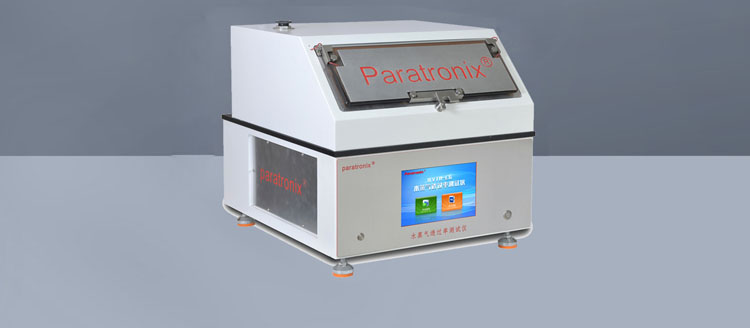
An ASTM E96 water vapor transmission rate tester measures how quickly water vapor passes through a material by tracking the mass of a sealed test assembly over time. A specimen separates the atmosphere inside a dish from a controlled environment outside it. As vapor moves across the specimen, the dish gains or loses mass, and that change is used to calculate the material’s water vapor transmission rate, or WVTR.
The important distinction is that the instrument does not directly count water molecules or measure the amount of liquid water leaking through a package. It measures a small change in mass caused by a difference in water vapor conditions across a material. The result describes performance under the conditions of that test, not a universal barrier value for every storage environment.
The principle behind the dish method
Water vapor tends to move from a region of higher water vapor partial pressure toward a region of lower partial pressure. In an ASTM E96 test, the specimen forms the boundary between those regions. The difference can be created using a desiccant inside the dish, water inside the dish, or another arrangement specified by the applicable procedure.
For example, when a dry desiccant is sealed beneath a film and the outside air is more humid, water vapor travels through the film toward the desiccant. The desiccant absorbs the vapor, so the mass of the test assembly increases. By recording that increase at intervals, the tester can establish how much vapor has passed through the exposed area during a given period.
The reverse arrangement uses water inside the dish. When the surrounding environment has a lower water vapor pressure, vapor moves outward through the specimen, and the assembly loses mass. Both arrangements rely on the same measurement principle, but they do not necessarily produce interchangeable results for every material.
ASTM E96/E96M covers gravimetric, or mass-based, methods for determining water vapor transmission of materials. The relevant edition and procedure should be checked before testing, because details such as specimen preparation, conditions, equipment and calculations matter to the validity of the result.
What the tester controls and measures
An ASTM E96 water vapor transmission rate tester is better understood as a test system than as a single sensor. Its essential components have different roles:
- Test dish and seal: hold the desiccant or water and secure the specimen so that vapor transfer occurs predominantly through the defined test area.
- Environmental control: maintains the specified temperature, humidity and air movement around the assembly.
- Balance: measures the mass of the complete assembly with sufficient resolution for the expected mass change.
- Time records and calculation: relate changes in mass to elapsed time and exposed specimen area.
Some systems automate weighing or record conditions electronically; others require the assembly to be weighed separately at specified intervals. Automation can change how the data are collected, but the fundamental measurement remains the mass change of the test assembly.
The exposed area is especially important. It is the area through which vapor can pass, not necessarily the full area of the cut specimen. Material covered by the sealing ring or sealant should not be treated as exposed test area. An incorrect area produces a proportional error in the calculated WVTR.
How a measurement develops over time
The test begins with specimen preparation. The material is cut to fit the dish, examined for damage, and mounted so that the test area is exposed. For a flexible film, avoiding wrinkles, pinholes and unintended stretching helps prevent the mounting operation from changing the result. If the two surfaces of a laminate differ, the exposed side should be identified and reported.
The dish is prepared with the medium required by the selected method. The specimen is then sealed to the dish perimeter. A reliable seal matters because mass change caused by vapor escaping around the edge is not the same as transmission through the material. The seal itself must also be suitable for the test conditions and remain intact throughout the measurement.
The assembled dish is placed in the specified environment and weighed at intervals. Early readings may reflect adjustment of the assembly and material to the test conditions rather than a stable transmission rate. The mass measurements are therefore assessed over time to identify the appropriate portion of the mass-versus-time curve for calculating the rate, in accordance with the selected procedure.
Once the relevant rate is established, WVTR is calculated from the slope of the mass change over time divided by the exposed area:
WVTR = rate of mass change ÷ exposed test area
If mass change is expressed in grams per day and area in square metres, the result is expressed in g/(m²·day). For illustration, a stable mass change of 0.002 g per day through an exposed area of 0.01 m² gives a WVTR of 0.2 g/(m²·day). This is a calculation example, not a performance specification.
The sign of the mass change identifies whether the assembly is gaining or losing mass. The reported transmission rate is generally discussed as a positive magnitude, with the test method and direction of vapor movement stated separately.
Desiccant and water methods: why the direction matters
In the desiccant method, a drying agent inside the dish creates a low-humidity condition beneath the specimen. Vapor enters from the controlled exterior, and the assembly gains mass. In the water method, liquid water inside the dish creates a high-humidity condition on one side of the specimen; vapor moves toward the less humid exterior, and the assembly loses mass.
The distinction is more than a choice between measuring gain and measuring loss. A material can respond differently to different humidity conditions. Some materials absorb moisture, and that absorption can alter their structure or transport behavior. The vapor pressure difference and the humidity experienced by the two surfaces can therefore affect the measured rate.
For multilayer packaging films, orientation also deserves attention. A coated surface, adhesive layer or moisture-sensitive layer may behave differently depending on which side faces the higher-humidity environment. Recording the specimen orientation helps make comparisons meaningful, especially when the intended application exposes one particular side to moisture.
A water method does not automatically mean that liquid water is in contact with the specimen. The test arrangement and selected procedure determine whether contact occurs. That distinction matters because direct liquid contact can affect some materials differently from exposure to water vapor alone.
Why temperature and humidity must accompany the result
A WVTR number without test conditions is incomplete. The movement of vapor depends on the difference in water vapor partial pressure across the specimen, and that difference is influenced by both temperature and relative humidity. Temperature can also affect how readily vapor moves through the material itself.
As a result, two laboratories can report different rates for the same film without either measurement being inherently wrong if they used different conditions. A value obtained under a particular temperature and humidity combination should not be treated as directly comparable to a value obtained under another combination.
Consider two packaging films with published WVTR values. If one was tested with a desiccant arrangement and the other with a water arrangement, the numerical ranking alone may not establish which film offers better protection in the intended package. The conditions, specimen orientation, thickness and reporting basis need to be aligned before the comparison can support a useful conclusion.
Other test details can matter as well: the conditioning of specimens, air movement around the dish, the type and condition of desiccant, and the duration over which mass changes are measured. These are not merely administrative details. Each can influence either the driving force for vapor transfer or the accuracy with which a small mass change is observed.
WVTR, permeance and permeability are not the same
WVTR describes the mass of water vapor passing through a unit area over a unit of time under stated conditions. It is useful when comparing specimens tested using the same conditions and reporting basis.
Water vapor permeance relates the measured transmission rate to the water vapor pressure difference across the specimen. It provides a way to express transmission with the driving pressure difference taken into account. A valid permeance calculation still depends on appropriate test conditions and assumptions about the pressures on the two sides.
Water vapor permeability additionally incorporates specimen thickness. For a suitable homogeneous material, it can be used to characterize the material rather than only a particular thickness of specimen. The relationship is less straightforward for multilayer structures, coatings, porous materials or products whose thickness and composition are not uniform.
For packaging films, a lower WVTR indicates less vapor transfer per unit area and time under the stated test conditions. It does not, by itself, identify the performance of an entire package. A finished pouch or container also includes seals, closures and other features that can contribute to moisture entry.
Sources of error in a mass-based test
Because some barrier materials transmit very little moisture, the mass changes being measured can be small. Balance resolution, stable weighing conditions and sufficient test duration become especially important. A balance that can display several decimal places is not automatically adequate: its repeatability and performance under the weighing conditions also matter.
Leaks around the dish edge can make a specimen appear to transmit more vapor than it actually does. Conversely, a seal that covers more material than accounted for reduces the true exposed area and distorts the calculation. Contamination, damage during handling, or a specimen that is not representative of the material can also compromise the result.
Changes unrelated to vapor passing through the specimen need attention. Spillage, handling, material shedding or loss of volatile substances can alter the measured mass. Temperature differences between the assembly and the balance environment can also affect weighing. Good practice follows the specified procedure for handling and weighing, rather than assuming every recorded mass change is caused by water vapor transmission.
Desiccant condition is another practical limit. A drying agent must provide the low-humidity environment required by the procedure throughout the relevant measurement period. If it becomes ineffective, the intended pressure difference can change. In a water-based arrangement, the water level and test setup likewise need to remain consistent with the chosen procedure.
For very high-barrier films, a dish method can require extended measurement time before the mass change is distinguishable from weighing variation. That does not mean the material is impermeable. It means the chosen setup may need more time, a suitable balance, careful control of extraneous effects, or a different validated test method for the measurement objective.
Reading an ASTM E96 test report
A useful report gives more than a single WVTR value. The selected standard edition and procedure, test temperature and humidity, specimen identification, exposed area, thickness where relevant, and result units provide the context needed to interpret the number. Specimen orientation, the number of specimens and the way results are summarized are also important when assessing variability or comparing reports.
The mass-versus-time record can add context where available. A rate derived from a consistent trend is more informative than a result based on an isolated difference between two readings. Unusual changes in slope may signal that the assembly or specimen was still adjusting, that test conditions changed, or that another source of mass change needs investigation.
ASTM E96/E96M describes a material-level test. It can help characterize a film, sheet or other suitable specimen, but a material result should not be presented as proof of the moisture protection delivered by a complete pharmaceutical package. Finished-package performance also depends on the configuration and integrity of the package. The most reliable comparison is therefore between clearly identified specimens tested under matched, documented conditions, with any package-level claim supported by an appropriate package test.
Leave A Reply
Search by Keywords