




Recent Posts
 What does ASTM F1249 require for medical packaging WVTR testing?Nov 13, 2026
 Infrared vs Gravimetric WVTR Testing for Food PackagingNov 13, 2026
 ASTM F1249 and ASTM E96: Choosing a WVTR Test Method for Food FilmsNov 13, 2026
 What does a WVTR tester measure in pharmaceutical containers?Nov 13, 2026
 ASTM F1249 and E96: WVTR Test Standards for Biodegradable FilmsNov 13, 2026
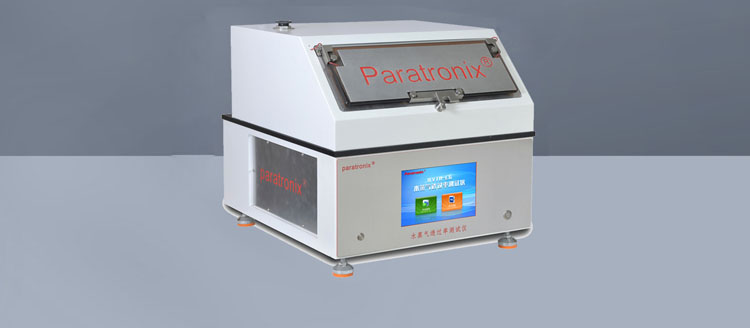
Selecting a WVTR tester for food packaging requires more than comparing specifications. Infrared and gravimetric methods differ in measurement principles, sensitivity, test conditions, and operational requirements—all of which can affect how engineers evaluate moisture-barrier performance. The right choice depends on the materials being tested, the decisions the results must support, and the way the laboratory actually works.
A laboratory checking incoming polyethylene film for a dry food pouch has a different problem from one qualifying a high-barrier laminate for a long-shelf-life product. Both may report water vapor transmission rate in g/m²/day, but that shared unit does not make every test setup—or every result—interchangeable.
What each method measures
In an infrared method, a film specimen separates a humid side from a drier side. Water vapor permeating through the film is transported to an infrared detector, which measures it through its absorption of infrared radiation. The instrument uses the detected signal and its calibration to calculate transmission. ASTM F1249 describes a procedure using a modulated infrared sensor; the relevant edition and instrument configuration should be checked before specifying a system.
In a gravimetric, or cup, method, the specimen seals a test dish containing a desiccant or water. The assembled dish is exposed to a controlled environment, and its change in mass is measured over time. The mass-change rate, adjusted for the exposed test area, is used to calculate WVTR. ASTM E96/E96M covers gravimetric water vapor transmission methods for materials, including desiccant and water procedures.
The practical distinction is not simply “electronic versus manual.” Infrared systems typically rely on a controlled gas path, detector response, calibration and flow conditions. Gravimetric testing relies heavily on dish preparation, sealing, environmental control and weighing. Both need a stable vapor-pressure difference across the specimen, and both can produce misleading results when the setup is poorly controlled.
Start with the barrier level, not the instrument brochure
For a relatively permeable film, a properly prepared gravimetric test may produce a measurable mass change within a practical period. For a high-barrier structure, the mass change can be very small. Balance performance, environmental stability, handling and seal leakage then become proportionally more significant. Extending the test may help, but it does not automatically remove systematic errors.
An infrared instrument may offer the sensitivity and automated monitoring needed for lower transmission rates, but “infrared” alone is not a guarantee of adequate performance. Ask for the validated measurement range under the intended conditions, not just the lowest number in a catalogue. Detection limit, quantitation capability, repeatability and the range over which the supplier supports reliable measurements are related but different claims.
The expected result should sit comfortably within the usable range. If the laboratory needs to distinguish between two laminate structures whose WVTR values are both close to the system’s lower limit, a nominal ability to display those values is not enough. Request evidence of repeatability on representative low-transmission materials, together with the test duration and conditions used to obtain it.
At the other end of the scale, highly permeable materials also deserve a range check. A system designed primarily for very high barriers may not be the most practical choice if the routine workload consists of materials outside its supported range or requiring frequent changes to the setup.
Test conditions can change the ranking
WVTR is not an intrinsic number that can be transferred from one data sheet to another without context. Temperature and relative humidity affect the driving force for water vapor transport, and some polymers respond to moisture differently as conditions change. A laminate that looks acceptable under one set of conditions should not automatically be assumed to behave proportionally under another.
When comparing infrared and gravimetric data, align the temperature, humidity on both sides, exposed area, specimen conditioning and reporting convention as closely as the methods permit. Also check which face of an asymmetric laminate faces the humid side. Coatings, paper layers and moisture-sensitive polymers can make orientation relevant.
A familiar source of disagreement is a wet-cup result being compared with an infrared result generated under a different humidity gradient. Neither value is necessarily wrong. They may simply describe different experiments. Confirm the actual humidity conditions at the specimen rather than relying on a shorthand description such as “high humidity.”
For supplier approval, the most useful agreement is often a shared written test protocol: specimen preparation, conditioning, temperature, humidity, orientation, number of replicates, endpoint and treatment of outliers. If a customer requires a specific standard or method, that requirement may outweigh an instrument’s convenience.
Where the laboratory time goes
Infrared systems can reduce repeated manual weighing and provide a continuous or instrument-managed view of the permeation response. That is attractive when a laboratory runs recurring comparisons and needs traceable electronic records. It does not mean every test is quick: specimen conditioning and the time needed to reach a stable transmission rate can still dominate the schedule, especially with barrier laminates.
Gravimetric equipment can be a practical route when the relevant transmission rate produces a dependable mass change and the laboratory already has suitable environmental control and weighing capability. Multiple dishes may be run in parallel, although each needs preparation, identification, scheduled weighing and review. The throughput calculation should include those tasks, not just the number of cups that fit in a chamber.
For either approach, ask what happens between samples. Sealing, cleaning, purging, conditioning and checking for leaks can determine real capacity. A specification that counts test stations but ignores turnaround time is a weak basis for a purchasing decision.
Film data is not a finished-package leak test
A flat-film WVTR test measures transmission through the exposed specimen under defined conditions. It does not directly capture every route by which moisture can enter a finished pack. Heat seals, folds, closures, pinholes and handling damage may have a different effect on package performance from permeation through intact film.
Consider a snack pouch that passes a film specification but loses crispness earlier than expected. Repeating the same flat-film test may confirm the material’s barrier, yet the investigation may also need seal integrity and finished-package evaluation. Conversely, a leak test cannot replace permeation testing when the question is whether a film structure provides enough moisture resistance.
Some instruments or fixtures can accommodate particular package formats, but capability should be verified for the actual shape, size and intended method. Do not assume that a flat-film system can test a formed container, sachet or closure without suitable accessories and a documented procedure.
Questions that separate a workable system from a risky purchase
Before requesting quotations, assemble a small set of representative specimens: the lowest-barrier and highest-barrier materials in the current workload, plus any difficult structures such as coated films or paper-based laminates. If possible, include materials near the acceptance limit. A demonstration using only an easy-to-measure sample says little about the instrument’s performance where the decision is hardest.
Use the same project brief to ask each supplier:
- Can the system run the required temperature and humidity conditions, and what tolerances apply at the specimen?
- What measurement range and repeatability are supported under those conditions and with the intended test area?
- How are calibration, verification, leak checks and reference materials handled?
- What criteria establish that the test has reached a stable reporting point, and can the raw time-based data be reviewed?
- How many samples can realistically be processed per shift, including preparation and changeover?
- What consumables, utilities, maintenance and operator training are needed?
For gravimetric testing, add questions about balance readability and suitability, chamber stability, weighing frequency, dish sealing and corrections required by the selected procedure. For infrared testing, examine detector verification, carrier-gas requirements, flow control and the availability of service support. In both cases, ask how the system flags an abnormal result rather than assuming the software can identify every leak or mounting error.
Paratronix Instruments Co., Ltd. manufactures packaging testing instruments for applications that include plastic and high-barrier materials and provides packaging testing solutions. When discussing an application with an equipment supplier, share the intended standard, material structures, expected WVTR range and laboratory constraints. Those details are more useful than a request for a generic “high-precision” tester.
Making the method decision
Gravimetric testing is worth serious consideration when the material produces a reliably measurable mass change, the required environment is available and manual handling fits the workload. Infrared testing is often attractive when low transmission rates, automated monitoring or frequent repeat testing justify the instrument and its operating requirements.
The decision becomes less subjective if both options are assessed against the same acceptance criteria. Define the lowest result that must be measured with confidence, the maximum useful turnaround time and the reproducibility needed to accept or reject a material. Then verify those requirements on representative specimens, using the conditions that will appear on the laboratory’s reports. That exercise is usually more revealing than comparing headline sensitivity claims.
Leave A Reply
Search by Keywords