




Recent Posts
 ASTM F88 Seal Strength Testing: Specimens, Test Setup and ReportingNov 19, 2026
 Choosing a Seal Strength Tester: Force Range, Grips and Test SpeedNov 19, 2026
 From Slip Angle to Friction: How Inclined Plane Testing WorksNov 19, 2026
 What Does an Inclined Plane Friction Tester Measure on Release Liners?Nov 19, 2026
 What Does a Glass Bottle Wall Thickness Tester Measure?Nov 18, 2026
A slip angle can be converted into a coefficient of static friction, but the result describes a specific pair of surfaces under a specific set of conditions—not an intrinsic property of a release liner. The conversion is straightforward: if a sled begins to slide at an angle of θ, the apparent static coefficient of friction is approximately tan θ. The difficult part is establishing exactly when sliding begins and ensuring that nothing other than friction is governing that motion.
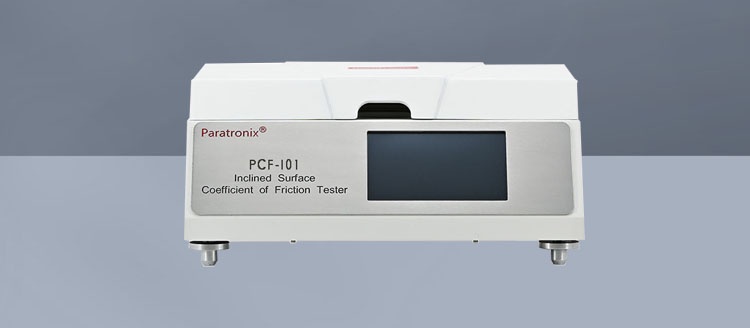
An inclined plane friction tester for release liners controls the tilt of a surface while a loaded sled rests on the material being evaluated. As the incline rises, the component of gravity pulling the sled downhill increases. The angle at which the sled starts to move provides a practical measure of resistance to the initiation of sliding. Surface orientation, contact pressure, conditioning, and the way the liner is mounted all influence what that number means.
Why the tangent of the slip angle represents friction
Consider a sled with mass m resting on a plane tilted at angle θ from horizontal. Its weight, mg, can be resolved into two components: mg sin θ acts parallel to the plane and pulls the sled downhill, while mg cos θ acts perpendicular to the plane and produces the normal force.
In a simplified dry-friction model, the limiting static friction force is the product of the static coefficient of friction, μs, and the normal force. At the threshold of sliding:
mg sin θ = μsmg cos θ
Dividing one side by the other gives:
μs = tan θ
For illustration, a slip angle of 20° corresponds to an apparent static coefficient of approximately 0.36. At 30°, the calculated value is approximately 0.58. These are mathematical conversions, not reference values or acceptance limits for release liners.
The mass cancels out of the ideal equation, but that does not mean sled weight is unimportant in a real test. Changing the load can alter contact pressure, deformation, the area of intimate contact, and the contribution of adhesion. The equation relates the observed threshold angle to a friction coefficient under the test conditions; it does not guarantee that the coefficient will remain unchanged at every load.
The tangent relationship is also nonlinear. A given difference in degrees does not represent the same difference in coefficient across the whole angle range. Comparing calculated coefficients is therefore useful, but the original angles should be retained in the test record so the conversion and any rounding can be checked.
What the measured angle actually represents
The slip angle is associated with the onset of motion, so it is primarily a measure of static friction. It does not directly provide the kinetic coefficient of friction during sustained sliding. Once a sled moves, its speed changes and the resisting force may differ from the force at the threshold. Determining kinetic friction generally requires a method that measures force during controlled relative motion.
The ideal model also assumes that the sled is not restrained by anything except friction. A curled specimen touching an edge guide, adhesive residue holding an edge, or a folded liner mechanically catching the sled can delay movement. Conversely, vibration or a sudden change in tilt speed can trigger motion before the intended threshold is reached. In either case, converting the angle to tan θ produces a number, but not necessarily a valid friction result.
It is helpful to distinguish initial movement from sustained sliding. A sled may twitch, rock, or move a short distance before stopping. Whether that event counts as slip must be defined by the applicable method. A camera, sensor, or operator may identify the event differently, particularly when movement is gradual. Using the same detection rule is essential when comparing samples.
Release-liner surfaces are not interchangeable
A release liner can present different surfaces on its two sides. The release-coated face, the reverse face, and any surface used as a counterface form different friction pairs. A result reported simply as “liner friction” leaves too much unspecified to reproduce or interpret the measurement.
Before testing, identify which face is in contact with the sled and what material covers the sled contact surface. A liner tested against itself is not directly comparable with the same liner tested against a metal, polymer, or other specified counterface. Surface chemistry and topography affect the interface, so changing either member of the pair can change the slip angle.
Direction matters as well. Some liners have directional surface characteristics arising from their substrate or manufacturing process. Testing along the machine direction and across it can yield different results. The selected direction should reflect the intended comparison or application and should be recorded with the specimen orientation.
Release performance should not be confused with sliding friction. Release force describes the force required to separate an adhesive construction from the liner under defined peeling conditions. Inclined-plane friction concerns the initiation of lateral movement between contacting surfaces. A low slip angle does not, by itself, establish that an adhesive will release easily, and a release-force result cannot be substituted for a friction measurement.
How the test setup changes the result
In a typical arrangement, a specimen is secured flat on a tilting platform and a sled with a defined mass and contact surface is placed on it. The platform is raised at a controlled rate until movement satisfies the specified slip criterion. Some methods may arrange the materials differently; the controlling procedure determines the configuration.
The setup needs enough detail to distinguish material behavior from fixture effects:
- Sled mass and contact area: Together these define nominal contact pressure. Sled construction and compliance also affect how the surfaces conform to one another.
- Specimen mounting: The liner should remain fixed without wrinkles, excessive tension, or adhesive from the mounting arrangement entering the test area. A loose or buckled sheet can alter the local slope or move with the sled.
- Tilt rate: A faster increase in angle changes the time available for contact and can affect the observed onset, especially where surfaces adhere or deform with time. Results from different rates should not be treated as automatically equivalent.
- Contact time: The delay between placing the sled and starting the incline can influence the interface. That delay should be controlled, along with any specified procedure for placing the sled without a horizontal push.
- Surface condition: Dust, fingerprints, transfer from a previous test, and cleaning residues can alter a low-friction interface. Cleaning practices must be compatible with the method and must not damage or modify the test surfaces.
- Environment: Temperature, relative humidity, and conditioning time can affect both the liner substrate and the interface. Record the conditions rather than assuming that nominal room conditions are equivalent across laboratories.
Specimen history can be just as important as the immediate setup. Storage, winding, contact with adjacent layers, and handling can influence the exposed surface. If two lots have different histories, a measured difference cannot automatically be attributed to the liner formulation alone. A comparison is stronger when specimens are conditioned and handled consistently and when the source and sampling location are recorded.
Repeated passes over the same track also require care. A first slide can change the surface through transfer, abrasion, or contamination. Unless the method calls for repeated testing of the same area, fresh contact areas and specimens help avoid treating a changed interface as an independent replicate.
Standards: choose the method before comparing numbers
Several standards address friction testing of packaging-related materials, but their scope and procedures are not interchangeable. ASTM D4918 concerns the coefficient of static friction of packaging materials using an inclined plane. ASTM D1894 addresses static and kinetic coefficients of friction of plastic film and sheeting using a horizontal-plane method. ISO 8295 also addresses coefficients of friction of plastic film and sheeting. The applicable edition, scope, specimen preparation, apparatus, and calculation requirements should be checked before a method is specified or a compliance claim is made.
A release liner may contain a film, paper, or composite substrate and a functional coating. Its suitability for a given standard depends on the standard’s scope and on the particular construction being tested. A published method may provide a useful starting point without resolving every detail of a release-liner interface. If a counterface, loading condition, or detection criterion is modified, the deviation should be documented; a modified procedure should not be presented as unqualified compliance with the original method.
Horizontal sled tests and inclined-plane tests also impose motion differently. A horizontal test generally draws one surface relative to another and measures force, whereas the inclined method increases the downhill component of gravity until sliding occurs. Differences in loading, motion, contact time, and detection can produce different results even for nominally similar materials. Numerical agreement should be established experimentally under defined conditions rather than presumed from the use of the same term, “coefficient of friction.”
Interpreting scatter and comparing materials
A single slip angle can conceal substantial variation. Multiple specimens sampled from defined locations provide a more useful picture of both the central result and the spread. Record individual angles as well as the reported summary, and apply the calculation and rounding rules specified by the chosen method. If results are converted to coefficients, calculate and summarize them according to that procedure: because tangent is nonlinear, the tangent of the mean angle is not generally identical to the mean of the individual coefficients.
Large scatter deserves investigation before it is attributed to inconsistent material. Check for variable specimen flatness, changing contact time, contamination, a worn sled face, inconsistent detection of first movement, or differences in coating side and direction. If those factors are controlled and the variation remains, it may be meaningful evidence of variation across the sampled material. The test record should make that distinction possible.
Angle measurement itself contributes uncertainty. At 20°, an angle change of one degree changes the calculated coefficient by roughly 0.02; the effect of the same angular difference becomes larger at steeper inclines. Instrument angle resolution alone is therefore not enough to establish measurement capability. Zero setting, tilt-rate control, mechanical stability, and the repeatability of slip detection all matter, as does the condition of the contact surfaces.
When two materials have close results, a small difference in their mean angles should be considered alongside the spread of repeated measurements and the controls used. A difference observed with one counterface or contact pressure should not automatically be applied to another. The practical comparison is between clearly defined surface pairs under a controlled procedure, not between universal friction rankings for the liners.
Reporting a result that can be reproduced
A useful report identifies the method and edition, any deviations, material and lot identification, face tested, counterface, test direction, sled mass and dimensions, conditioning, tilt rate, contact time, and the rule used to detect slip. It should include the number of determinations, individual slip angles or the method-required reporting format, calculated coefficients where applicable, and any observations such as rocking, intermittent movement, or specimen curling.
The most defensible conclusion is specific: under the stated conditions, one surface pair began to slide at a measured angle, corresponding to a calculated apparent static coefficient. That conclusion is directly useful for comparing defined specimens, while preserving the distinction between a controlled friction test and the behavior of a liner in a different contact, load, or operating environment.
Leave A Reply
Search by Keywords