




Recent Posts
 ASTM F88 Seal Strength Testing: Specimens, Test Setup and ReportingNov 19, 2026
 Choosing a Seal Strength Tester: Force Range, Grips and Test SpeedNov 19, 2026
 From Slip Angle to Friction: How Inclined Plane Testing WorksNov 19, 2026
 What Does an Inclined Plane Friction Tester Measure on Release Liners?Nov 19, 2026
 What Does a Glass Bottle Wall Thickness Tester Measure?Nov 18, 2026
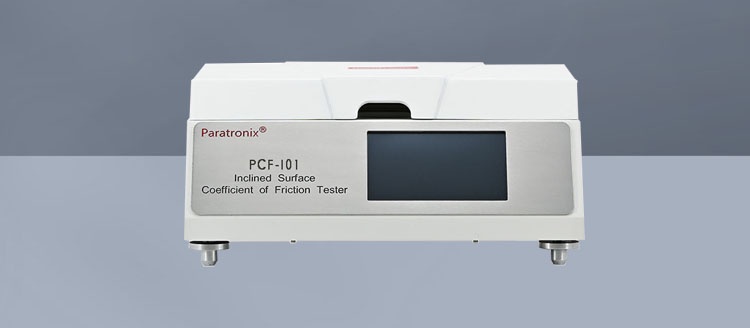
Release liners must move reliably through converting and dispensing equipment, but variations in surface friction can contribute to feeding problems, misalignment, or inconsistent handling. An inclined plane friction tester for release liners helps evaluate how readily a liner surface begins to slide against another material as the test angle increases. The result can make an otherwise subtle surface difference easier to compare—but only when the contact materials and test conditions are understood.
The central point is that the tester measures the angle at which sliding begins for a specified pair of surfaces. From that angle, an apparent static coefficient of friction may be calculated under suitable assumptions. It does not, by itself, measure the force required to peel a liner away from an adhesive.
What happens during an inclined plane test?
In a typical test, one specimen is secured to a flat platform, while a second contact surface rests on it, often attached to a sled or another specified load. The platform is raised gradually. As its angle increases, the component of gravity acting parallel to the surface increases until the upper specimen starts to slide. The instrument records the angle at that moment.
Imagine a release liner passing over a machine guide. The liner’s behavior depends not only on the liner itself, but also on the guide material and the side of the liner in contact with it. An inclined plane test represents a controlled surface pairing of this kind. It does not reproduce every detail of a running production line, but it can provide a useful comparison when samples are prepared and tested consistently.
Depending on the instrument and method, the start of motion may be detected automatically or observed by an operator. The chosen endpoint matters: a brief movement, a sustained slide, and a specified travel distance are not necessarily equivalent events. Results are most useful when the report identifies how sliding was determined.
From sliding angle to apparent static friction
The most direct result is the inclination angle at the onset of sliding, usually reported in degrees. Under an idealized model in which gravity acts on the upper body and no significant additional forces affect motion, the apparent static coefficient of friction can be estimated as:
Static coefficient of friction ≈ tan(θ)
Here, θ is the angle at which sliding starts. A larger angle generally corresponds to greater resistance to the start of sliding for that particular surface combination; a smaller angle indicates that movement began on a shallower slope.
The word “apparent” is important. Real release liners may curl, deform, stick locally, or make uneven contact with the opposing surface. Sled design, specimen mounting and the way the endpoint is detected can also affect the result. The tangent relationship is a useful interpretation, not proof that every contact behaves like an ideal rigid-body model.
The test principally addresses static friction: resistance before sliding begins. It should not be confused with dynamic, or kinetic, friction, which describes resistance while surfaces are already moving relative to each other. If behavior during continuous movement is important, a separate method designed to measure friction during sliding may be needed.
Which release liner surfaces are being compared?
A friction value belongs to a contact pair, not to a liner in isolation. A paper or film liner may have a silicone-coated release side, an uncoated or treated reverse side, and different surface characteristics on each face. Each can behave differently against another material.
Depending on the question being investigated, a test might compare:
- Liner against liner: useful when considering how sheets or layers contact one another during handling.
- Liner against a reference material: useful for controlled comparisons between samples, provided the same reference is used throughout.
- Liner against a representative machine-contact material: potentially helpful when investigating a particular guide, plate, or other contact point, if the test setup accommodates it.
The face orientation should always be recorded. “Release liner versus steel,” for example, is incomplete unless the report also states which liner face contacted the steel and how the surfaces were prepared. A result from the release-coated face may not describe the behavior of the reverse face at all.
Likewise, a clean reference surface is not necessarily representative of a production surface affected by wear, dust, or residues. A controlled reference test supports repeatability; a test using a representative contact material may provide additional practical insight. The two answer related but different questions.
Friction is not the same as release force
This distinction matters for anyone evaluating pressure-sensitive label stock or other adhesive constructions. A release liner is designed to separate from an adhesive under defined conditions. The force required for that separation is commonly evaluated with a peel or release-force test. It depends on the adhesive, liner coating, peel angle, speed, dwell time and other conditions.
An inclined plane friction test instead concerns sliding between surfaces placed in contact. A liner that releases cleanly from an adhesive is not automatically easy to slide over a guide. Conversely, a low sliding angle does not establish that the liner will peel from an adhesive at the desired force.
Both measurements may be relevant to the same packaging material, but they should not be used interchangeably. When the concern is whether a label separates correctly from its backing, investigate release performance. When the concern is whether a surface starts moving readily against another surface, friction testing is the more direct question.
Why friction measurements matter in converting and packaging
Release liners are handled in rolls, webs and sheets across processes that may include coating, printing, die-cutting, label dispensing and packaging operations. Surface friction can influence how those materials interact with machine components and with one another.
For example, a liner that resists the start of sliding more than expected may behave differently at a guide or contact point. A liner that slides too readily may also be difficult to control in an application that relies on sufficient grip or stable stacking. Neither a high nor a low result is universally better; suitability depends on the process and the surfaces involved.
Test results can support several practical decisions:
- Comparing incoming liner batches when the material construction and test conditions are consistent.
- Screening candidate paper or film liners before more extensive equipment trials.
- Investigating whether a change in coating, substrate, storage, or handling coincides with a change in surface behavior.
- Providing a common measurement for conversations between material suppliers, converters and packaging teams.
A friction result should be treated as evidence, not a complete diagnosis. Web tension, alignment, roller condition, static electricity and equipment settings may also affect handling. If a line develops a feeding problem, comparing friction data with those operating conditions gives a more useful picture than assuming one number explains the entire event.
What affects the result?
Small differences in preparation can make a meaningful difference to a surface test. Before comparing results, check whether the following conditions were kept consistent.
Specimen condition and orientation
Cut specimens carefully and identify the test face and machine direction where relevant. Curling, folds, wrinkles, edge damage or poor mounting can change contact with the opposing surface. For some materials, friction may vary with direction, so comparisons should use the same orientation unless directional behavior is the subject of the investigation.
Contact material, load and dwell time
The opposing surface should be identified and kept in a consistent condition. Scratches, contamination and residue may alter contact. The mass or applied load, sled geometry, contact area and time surfaces remain together before the plane is raised should also follow the chosen method. Longer contact may affect the onset of motion for some material combinations.
Environment and handling
Temperature and relative humidity can influence substrate properties and surface behavior, particularly for paper-based materials. Handling can introduce fingerprints, dust or other contaminants. Condition specimens as required by the applicable method, and record the environment so that later comparisons have context.
Rate of inclination and endpoint
Raising the plane at different rates can produce results that are not directly comparable. The same is true if one test records the first visible movement and another records sustained sliding. Use the procedure specified by the selected method or instrument, and document any deviations.
How should results be reported and interpreted?
A single angle can be informative, but a group of measurements usually provides a clearer view of a material’s behavior. Repeated tests can show whether results are closely grouped or whether individual specimens vary substantially. Such variation may be relevant when a production concern is intermittent rather than constant.
A useful report identifies the liner construction where known, the face tested, the opposing material, specimen orientation, conditioning, load or sled arrangement, inclination rate, endpoint and number of replicates. Report the individual angles or an appropriate summary, along with any calculated coefficient and the calculation method. Note unusual behavior, such as curling or irregular movement.
When comparing two liners, resist the temptation to focus only on which has the lower average. Ask whether both were tested against the same surface, in the same direction and under the same conditions. If one result was obtained with a different setup, the difference may reflect the method rather than the material. Relevant standards or agreed customer procedures should be checked for their scope and requirements before results are compared across laboratories.
Choosing a test approach for the question
An inclined plane method is a practical starting point when the question is, “At what angle does this liner begin to slide against this surface?” It is less complete when the question concerns friction throughout a movement, adhesive release, or performance under the full speed and tension of a converting line. In those cases, complementary testing and equipment trials may be needed.
For teams assessing packaging materials, Paratronix Instruments Co., Ltd. develops and supplies packaging testing instruments and provides testing solutions across applications including plastic packaging and high-barrier materials. A discussion about the liner construction, contact surface and intended use can help clarify which measurement is relevant before a test setup is selected.
Ultimately, the value of an inclined plane friction tester for release liners lies in making surface behavior measurable and comparable. The angle of initial sliding is a clear starting point; careful control of the surface pairing and test conditions is what turns that number into useful information.
Leave A Reply
Search by Keywords