




Recent Posts
 Does your inclined plane friction tester meet TAPPI T 815 requirements?Oct 27, 2026
 TAPPI T 815: What to Check Before Choosing an Inclined Plane COF TesterOct 27, 2026
 Inclined Plane vs. Horizontal COF Testers: Which Fits Your Paper Testing Needs?Oct 27, 2026
 What Can an Inclined Plane COF Tester Tell You About Packaging Slip?Oct 27, 2026
 Which WVTR Tester Is Suitable for Pharmaceutical Packaging?Oct 26, 2026
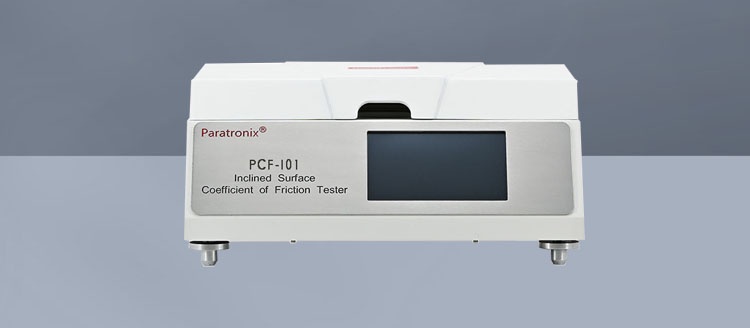
Choose an inclined plane tester when the required result is the onset of sliding under a gradually increasing slope, especially when an existing paper specification uses that method. Choose a horizontal COF tester when the evaluation requires both breakaway resistance and friction during continued sliding. If a customer specification names a test method, that requirement takes priority over which instrument appears to resemble the application more closely.
An Inclined Surface Coefficient of Friction Tester measures the angle at which a loaded specimen starts to slide. A horizontal tester records the force needed to initiate and maintain movement between contacting surfaces. Both characterize friction, but their results reflect different loading histories and measurement conditions. Selecting between them requires a clear definition of the material interface, the failure being investigated, and the result needed for acceptance.
Start with the friction event that matters
Paper feeding, stacking, and converting do not involve a single friction condition. A sheet resting against another sheet presents a breakaway problem. Once relative movement begins, sliding friction becomes relevant. Equipment selection becomes clearer when those events are separated.
For a stack that must resist movement on a sloped support, the angle at first slip provides a directly understandable screening result. An inclined plane setup is well suited to comparing that behavior under a defined load and contact arrangement. However, a small specimen beneath a sled does not reproduce an entire stack, where pressure distribution, sheet alignment, and deformation also influence stability.
For sheet separation or sliding through a converting operation, a horizontal instrument provides additional information. Its force trace distinguishes the initial peak from the resistance measured over a defined sliding distance. Two papers with similar breakaway friction can have different sliding friction, producing different behavior after movement starts.
The contacting pair must also match the question. Paper against paper characterizes intersheet friction. Paper against a specified metal surface addresses a different interface. Paper against a rubber feed roller involves contact mechanics that a standard flat sled arrangement does not fully reproduce. A COF result supports process diagnosis only when the tested surfaces represent the relevant contact.
What each instrument actually measures
Inclined plane: translating first movement into static COF
During an inclined plane test, the platform rises until the loaded specimen begins to move. Under the ideal force balance, the static coefficient of friction equals the tangent of the sliding angle:
Static COF = tan θ
Here, θ is the platform angle at the defined onset of sliding. The calculation assumes that gravity and friction govern movement, without significant interference from specimen edges, restraint, vibration, or other forces. Curl that catches against a fixture, for example, changes the event being detected.
The onset criterion deserves attention. Initial movement can be a small displacement, a brief slip, or sustained travel. Visual observation and automatic detection can identify different points unless the procedure defines movement consistently. Platform tilt rate also matters because it determines how quickly the driving force increases and how long the surfaces remain in contact before sliding.
The normal force decreases as the platform rises. This is part of the method, but it matters when comparing materials whose apparent friction changes with contact pressure. An angle-derived value should therefore retain its method identity when reported.
Horizontal testing: separating breakaway from continued sliding
A horizontal tester measures the tangential force needed to move a sled or specimen against its contacting surface. Dividing the measured friction force by the normal force gives the coefficient of friction. With an aligned horizontal pull and a level test bed, the normal force is approximately the weight of the loaded sled.
The initial force peak is used to determine static COF according to the selected procedure. Kinetic COF is calculated from a specified portion of the force record after sliding begins. The averaging interval matters: including the starting transient or the end of travel changes the reported value.
Drive acceleration, pull-line alignment, mechanical compliance, and force sampling affect the recorded peak. A short, sharp peak requires sufficient measurement response. For uneven sliding, the trace also reveals fluctuations that a single average conceals. Horizontal testing offers this diagnostic detail when the instrument records and retains the force data.
Compare capabilities against the required result
Automation improves consistency only when it controls the variables that affect the result. Automatic angle capture does not correct an undefined sliding criterion. Similarly, automatic force averaging does not make a horizontal result meaningful if the selected interval includes acceleration or specimen travel beyond the usable surface.
Paper preparation can change the equipment comparison
Before comparing instruments, define which paper faces contact each other. Coated and uncoated sides, printed and unprinted areas, or different surface treatments can produce different friction behavior. A face-to-face test and a face-to-back test answer different questions, even when the specimens come from the same sheet.
Direction must remain controlled as well. Cutting and mounting specimens without preserving machine direction and cross direction can mix surface orientations within one dataset. Directional texture or treatment makes that variation especially important. Record the sliding direction relative to the sheet orientation rather than relying on an unlabeled specimen stack.
Moisture conditioning influences paper stiffness, surface conformity, and contact behavior. Specimens tested immediately after arriving from a different environment can drift during measurement. Use the conditioning atmosphere and exposure period required by the governing procedure, and keep the testing environment consistent. Recording ambient conditions helps distinguish an instrument difference from a material conditioning difference.
Contact history creates another source of variation. Repeated travel over the same track can polish the surface, displace loose fibers, transfer coating material, or redistribute surface additives. A repeated test on one pair of specimens is therefore different from a replicate using fresh surfaces. The method must define which approach applies.
Sled mass and apparent contact area also require control. Although an ideal friction model treats COF as independent of these quantities, paper surfaces deform and interact through distributed contact points. Changing sled mass or footprint can alter the measured response. Results from different setups should not be treated as equivalent merely because both instruments display a dimensionless coefficient.
Use the specified method to protect comparability
Where a purchase specification or quality agreement defines the test method, equipment selection begins with that document. Confirm the required geometry, specimen arrangement, loading, movement conditions, conditioning, and calculation procedure against the instrument configuration. A general claim that an instrument supports paper friction testing does not establish conformity with every paper friction method.
Static COF values obtained by inclined and horizontal methods should not share an acceptance limit without evidence supporting that use. The methods apply force differently and can detect the onset of movement differently. A numerical difference does not, by itself, establish that either instrument is inaccurate.
When replacing an existing instrument, compare representative grades across the working range, including materials near acceptance boundaries. Preserve specimen preparation and conditioning, and use enough independent specimens to separate material variability from measurement variation. If the methods rank materials differently, a simple conversion factor is unlikely to resolve the problem.
A useful comparison examines both average results and the decisions they produce. Agreement on smooth, stable paper does not establish agreement on curled, embossed, heavily coated, or otherwise difficult specimens. Those materials test whether the fixture and detection system remain suitable for the intended workload.
Assess instrument performance with representative specimens
For an inclined plane instrument, assess angle measurement accuracy, tilt motion, platform rigidity, and sliding detection. A movement sensor should reliably identify the event defined by the procedure across the expected paper surfaces. Transparent overlays, low contrast printing, or irregular specimen edges warrant attention if detection relies on optical features.
For a horizontal instrument, match the force measurement range to the expected friction forces. An oversized range can limit useful resolution at low forces, while insufficient capacity risks overload during high breakaway events. Resolution alone does not establish measurement accuracy; calibration, response, alignment, and mechanical behavior also matter.
Pull geometry deserves a physical inspection. An upward component of tension reduces normal loading and changes the calculated result. Slack or excessive elasticity in the connection can distort the initial force peak. The sled should travel without rocking, edge contact, or interference from specimen fastening.
Trial measurements should retain enough information to explain rejected or unusual results. For inclined testing, that includes the measured angle and the observed sliding event. For horizontal testing, retain the force trace and calculation interval. A reported COF without its measurement context makes troubleshooting unnecessarily difficult.
Resolve the choice around the acceptance decision
An inclined plane tester is the appropriate choice when the controlling procedure specifies incline-based static friction, or when slip initiation under a rising slope is the defined evaluation. Its value lies in a clear measurement event and a controlled relationship between angle and breakaway behavior.
A horizontal tester fits evaluations that require static and kinetic friction, controlled sliding speed, or force-trace analysis. It is particularly useful when acceptable breakaway performance still leaves unexplained problems during continued sheet movement. Its additional outputs require equally clear settings for speed, acceleration, and data analysis.
If both questions exist, establish separate test purposes and acceptance criteria. A grade can satisfy a stacking-related static friction requirement while showing unsuitable sliding behavior at another interface. Keeping each result tied to its specimen pairing, method, and operating conditions makes that difference actionable.
Leave A Reply
Search by Keywords