




Recent Posts
 Which WVTR Tester Is Suitable for Pharmaceutical Packaging?Oct 26, 2026
 Heat Seal Tester vs Hot Tack Tester: Which ASTM Standards Apply?Oct 24, 2026
 Gas Permeability Testing: Differential or Equal Pressure?Oct 24, 2026
 ISO 9187 and Ampoule Break Force Testing: Which Requirements Apply?Oct 24, 2026
 What does a syringe needle puncture tester measure during insertion?Oct 24, 2026


Which WVTR Tester Is Suitable for Pharmaceutical Packaging?
Moisture ingress can compromise drug stability, making water vapor transmission rate (WVTR) testing essential when evaluating pharmaceutical packaging barriers. Which WVTR tester is suitable for pharmaceutical packaging? The answer depends on the packaging format, expected barrier performance, required quantitation limit, and applicable test method—not simply the lowest number on an instrument specification sheet.
For flat pharmaceutical films, an infrared-sensor instrument is often a practical starting point. For very low-permeability materials, a suitably configured electrolytic or other high-sensitivity system may deserve closer evaluation. Bottles, formed blisters, and sealed packages introduce a different question: can the equipment measure the actual packaging system without the fixture dominating the result?
Those distinctions matter more than choosing a technology by name. A tester that works well for incoming polymer film inspection may not answer a development team’s questions about a finished blister pack.
Start with the specimen, not the sensor
A flat-sheet WVTR result describes moisture transmission through a defined area under specified temperature and humidity conditions. It is useful for comparing candidate films, checking incoming materials, or investigating whether a laminate meets an agreed barrier specification.
However, a pharmaceutical package is rarely just a flat sheet. Thermoforming changes thickness distribution. Sealing introduces interfaces. A bottle adds a closure, liner, and potentially a desiccant. These features can change the moisture exposure experienced by the drug product.
Consider a development team comparing blister forming webs. Testing the unformed materials is a sensible screening step. Once a material is selected, testing representative formed and sealed packs addresses a different risk: whether the conversion process has compromised the intended protection. Neither measurement replaces the other.
Before requesting quotations, define whether results must be reported per unit area or per package per day. Converting between those reporting bases requires justified assumptions; multiplying a flat-film value by package area does not automatically account for seals, closures, or forming effects.
Comparing the main WVTR measurement approaches
Sensor technology affects sensitivity, operating requirements, and method compatibility. The comparison below is a selection guide, not a ranking: actual capability depends on the complete instrument, including its cell, gas path, humidity control, and software.
Infrared instruments detect water vapor carried from the specimen’s transmission side. They can be convenient for laboratories handling recurring film specifications. ASTM F1249 addresses water vapor transmission through plastic film and sheeting using a modulated infrared sensor; ISO 15106-2 covers an infrared detection sensor method.
Electrolytic systems measure water through an electrochemical process. ISO 15106-3 addresses the electrolytic detection sensor method. These systems can be candidates for demanding low-transmission work, but “electrolytic” is not itself proof of superior usable sensitivity. Moisture in carrier gas, tubing, seals, or the test cell can obscure a small specimen signal.
Gravimetric methods determine transmission from mass change over time. ASTM E96/E96M is a relevant reference for gravimetric water vapor transmission testing of materials. This approach can be appropriate where the required method and expected transmission support it. For very high-barrier specimens, however, the mass change may be too small to resolve conveniently within an acceptable test duration.
Always check the current standard’s scope and procedure against the proposed application. A supplier’s “complies with” statement should identify the exact configuration and method supported, rather than imply that every specimen format is covered.
For high-barrier packaging, look beyond the advertised lower limit
The lower end of a published measurement range is not necessarily a practical quantitation limit for your material. A system may detect a small change without measuring it with enough repeatability to distinguish acceptable material from a borderline batch.
Ask for performance evidence near your decision threshold, not only at a convenient mid-range value. Useful evidence includes repeated measurements, blank-cell behavior, reference-material checks, and the conditions under which those results were obtained.
Exposed specimen area also matters. At the same area-normalized WVTR, a smaller specimen transmits less total water. An adapter that accommodates a tiny blister sample may therefore make the measurement harder, even though the software still displays the same units.
For foil-containing laminates, the practical result may be governed by pinholes, damage, or edge leakage rather than transmission through an intact barrier layer. If the result is below the method’s demonstrated quantitation capability, report it accordingly. A displayed zero should not become a claim of absolute impermeability.
Finished blisters and bottles need more than a film clamp
Whole-package testing requires a defined boundary: which surfaces, seals, and closure components are included in the measurement? A fixture that masks part of a package may be useful for development, but its result must not be presented as total package moisture ingress unless that interpretation is justified.
The fixture’s own background contribution becomes especially important when evaluating highly protective packs. Adhesives, gaskets, and connection points can introduce moisture pathways or release retained moisture. Request blank-fixture measurements and an explanation of how background is controlled or corrected.
For applicable pharmaceutical container assessments, USP <671> provides performance-testing procedures that include moisture vapor transmission evaluations. It should not be treated as a blanket endorsement of any particular sensor. Confirm the applicable procedure, package category, and acceptance criteria before deciding whether an instrumental setup answers the required question.
WVTR testing also does not replace container closure integrity testing. Moisture transmission and leakage can both affect package performance, but a barrier measurement alone does not establish the absence of integrity defects.
Conditions and throughput can change the buying decision
Two results are not directly comparable merely because both are expressed in g/m²/day. Temperature, humidity difference, specimen orientation, conditioning, and steady-state criteria must be aligned. Polymer permeability can change with temperature and moisture exposure, so results should not be extrapolated casually between conditions.
This is particularly relevant when comparing supplier data with internal measurements. Before attributing a discrepancy to material quality, check the test conditions, exposed area, sample preparation, and reporting rules.
Throughput deserves the same scrutiny. Multiple cells do not necessarily provide fully independent testing or simultaneous results. Ask whether cells share a sensor, how measurement time is allocated, and whether samples with very different transmission levels can be run together without unacceptable delays.
For a mixed laboratory workload, recovery after a higher-transmission specimen may be as consequential as nominal test speed. A useful supplier demonstration should include the transition from a relatively wet sample to a high-barrier specimen, not only a sequence of similar materials.
What to verify before accepting an instrument
A demonstration becomes much more informative when it follows your intended laboratory workflow. Send representative specimens and agree on the evaluation criteria in advance.
- Measurement fitness: Test a routine material and a demanding low-transmission specimen, with replicates sufficient to assess repeatability.
- Preparation sensitivity: Review mounting, edge sealing, conditioning, and handling precautions, particularly for fragile barrier coatings.
- Traceable records: Check whether reports retain conditions, specimen area, calibration status, raw measurement history, and the basis for ending a test.
- Operational requirements: Confirm gas quality, consumables, maintenance access, calibration arrangements, and support for installation and qualification documentation.
Where electronic records support regulated decisions, assess access controls, audit trails, data retention, and validation requirements with the responsible quality team. These requirements depend on intended use; they cannot be established by a generic software compliance claim.
Choosing a configuration with Paratronix Instruments
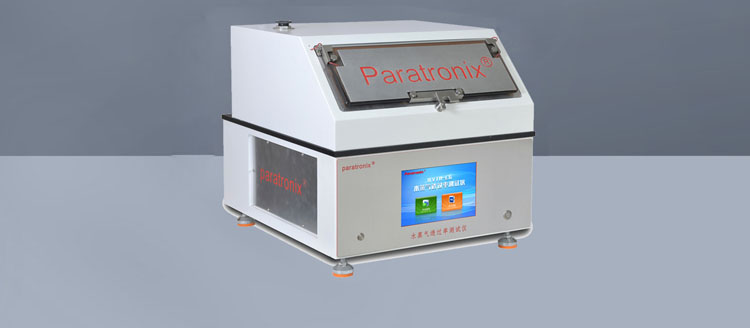
Paratronix Instruments Co., Ltd. manufactures packaging testing instruments for pharmaceutical packaging, plastic packaging materials, and high-barrier materials. Its focus on instrument research, development, and packaging testing solutions provides a starting point for discussing both material evaluation and package-level testing needs.
The useful conversation is application-specific: provide the material structure, specimen dimensions, expected WVTR, required conditions, applicable method, and daily workload. Ask Paratronix to confirm the proposed configuration’s suitability through documented specifications and representative sample testing. Whole-package fixtures, low-level performance, and qualification support should be confirmed rather than assumed.
For routine flat-film control, a validated infrared configuration may be the most practical choice. For exceptionally low transmission, prioritize demonstrated quantitation capability over sensor labels. For finished pharmaceutical packages, make fixture performance and method relevance the deciding factors. Purchase the system that can support your actual acceptance decision—not the one with the most impressive minimum-range claim.
Leave A Reply
Search by Keywords