




Recent Posts
 Key Specifications to Compare When Selecting a Lipstick Break Force TesterOct 08, 2026
 What Does a Lipstick Break Force Tester Measure in Quality Control?Oct 08, 2026
 Validation Records and Test Standards for Artificial Skin Puncture TestingSep 24, 2026
 Force Tester or Universal Testing Machine for Artificial Skin Puncture Tests?Sep 24, 2026
 What Does an Artificial Skin Puncture Force Tester Measure in Needle Testing?Sep 24, 2026

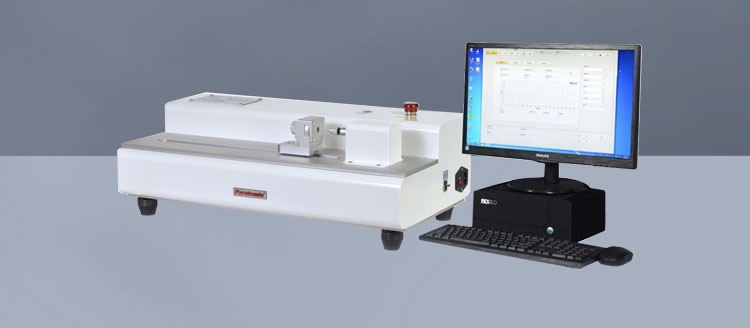
Scope and Application of ASTM D1777
ASTM D1777 is the internationally recognized Standard Test Method for Thickness of Textile Materials. This essential procedure provides the definitive method for measuring the thickness of most textile fabrics, a fundamental physical property that significantly impacts performance, quality, and compliance .
The standard applies to a wide range of materials, including woven fabrics, knitted fabrics, blankets, napped fabrics, pile fabrics, layered fabrics, and air bag fabrics. These materials may be untreated, sized, coated, or resin-treated . It is a critical tool used extensively in trade for the acceptance testing of commercial shipments due to its established reliability between different laboratories .
The Physics of Measurement: Why Pressure is Critical
The core principle of this test method is a controlled contact measurement. A weighted presser foot (anvil) is lowered onto a specimen placed on a flat base, and the distance between the surfaces is measured as the thickness . However, a single, universal truth governs textile thickness: the apparent thickness varies inversely with the pressure applied during measurement .
Pressure Dependence: Most textile materials are compressible. A higher pressure will compress the fibers, yarns, and fabric structure, yielding a lower thickness reading. Conversely, a very light pressure might not fully contact the surface, overestimating thickness .
Standardized Conditions: Therefore, ASTM D1777 does not prescribe a single universal pressure. Instead, it provides the framework for measurement, emphasizing that the applied pressure must always be specified when reporting any thickness value . The specific pressure and presser foot size are typically dictated by the material specification or a relevant purchase contract.
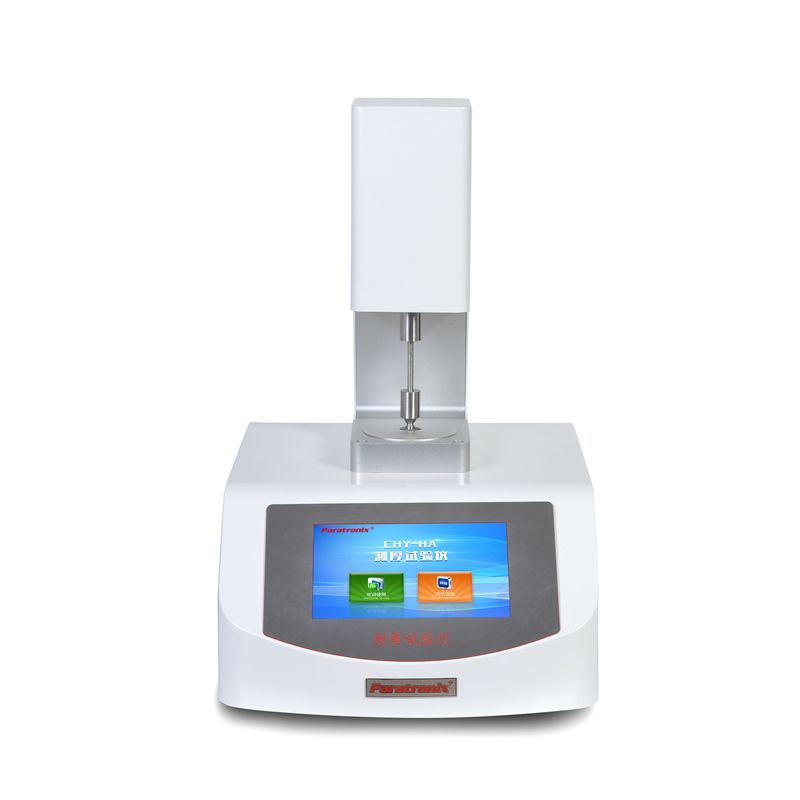
Testing equipment:PTT-03 Thickness Tester
Ensuring Accuracy: Significance, Dispute Resolution, and Limitations
Accurate thickness measurement is vital for quality control, product development, and trade. Thickness values are used to estimate bulk, warmth, and to measure performance changes after processes like abrasion or shrinkage . The standard is considered satisfactory for acceptance testing in commercial transactions .
A notable and practical section of the standard details a statistical procedure for resolving disputes. If a buyer and supplier report different test results, the standard recommends a comparative inter-laboratory study using homogeneous samples from the same lot of material. With competent statistical analysis, the parties can determine if a consistent bias exists between their labs and agree on how to account for it in future transactions .
It is important to note that ASTM D1777 has defined limitations. Its directions may be superseded by a primary test method written for a specific material. This standard is to be used in its entirety only when no such specialized method exists .
Leave A Reply
Search by Keywords