




Recent Posts
 What Does an Adhesive Tack Tester Measure in Pressure-Sensitive Tapes?Oct 15, 2026
 Which gases can a gas transmission rate tester actually measure?Oct 14, 2026
 Should you choose a differential-pressure gas transmission rate tester?Oct 14, 2026
 Does your gas transmission rate tester meet ASTM D1434 requirements?Oct 14, 2026
 Horizontal vs. Vertical Peel Testers: Which Fits Your Specimens and Fixtures?Oct 14, 2026


A pressure-sensitive tape may feel sticky to a fingertip yet fail to catch a moving package during a brief application window. Another tape may grip immediately but gradually slip under a sustained load. Both observations concern adhesion, but they describe different properties.
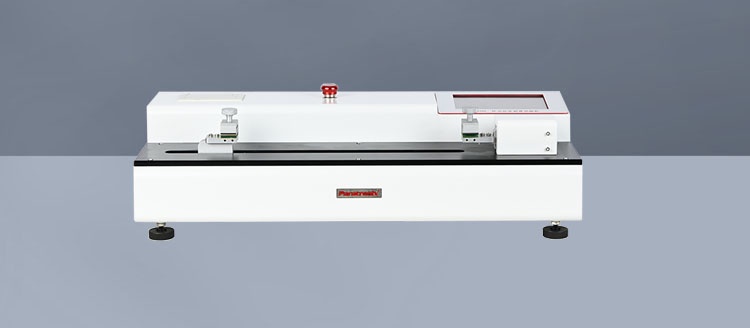
An Adhesive Tack Tester measures how readily an adhesive forms an initial bond under defined contact conditions. Depending on the method, the result may be a separation force, the energy required to separate contacting surfaces, or a rolling-ball stopping distance. It is not, by itself, a measure of long-term holding power.
For packaging researchers, understanding that distinction makes tape specifications much easier to interpret. The useful question is not simply “How sticky is this tape?” but “How does it bond during the short contact period our application actually allows?”
Tack is the beginning of a bond—not its entire performance
Pressure-sensitive adhesives bond through contact and applied pressure without requiring activation by water, solvent, or heat during normal use. For that bond to develop, the adhesive must establish intimate contact with the receiving surface, often described as wetting the substrate.
Tack reflects this early-stage bonding behavior. A tack test brings an adhesive into contact with a defined surface under controlled conditions, then evaluates its response. Contact time is usually brief, although the exact duration and loading conditions depend on the procedure.
Three properties are often confused when people discuss tape adhesion:
- Tack: the ability to develop a bond during brief contact, evaluated under a specified procedure.
- Peel adhesion: resistance to removal by peeling at a defined angle and speed, usually after controlled application and dwell.
- Shear holding power: resistance to sliding or failure under a sustained load acting parallel to the bonded surface.
A tape can perform strongly in one category without doing so in another. A relatively soft adhesive may establish contact rapidly but deform under prolonged loading. A formulation designed for strong holding power may need more application pressure or time to develop useful adhesion. That is why one tack number cannot describe overall tape quality.
What an Adhesive Tack Tester measures depends on the method
“Tack tester” describes a category of equipment rather than one universal measurement system. The fixture, contact geometry, loading sequence, and measurement principle determine what the reported value means.
Loop tack: force required to separate a briefly contacted tape loop
In a loop tack test, a strip of tape is formed into a loop with its adhesive side facing outward. The loop contacts a specified test surface and is then withdrawn under controlled conditions. The instrument records the force generated during separation.
The principal result is commonly the maximum separation force, reported in force units for a specified specimen width or normalized by width, depending on the procedure. Some systems also provide the full force–displacement curve.
Loop tack is useful for comparing the initial bonding behavior of tapes and other flexible pressure-sensitive materials. However, the result also reflects specimen mechanics. Backing stiffness, loop geometry, contact area, and movement speed can influence the reading. Two tapes with different backings therefore need careful interpretation, even if their adhesive formulations are similar.
Probe tack: controlled contact followed by normal separation
A probe tack test brings a probe of specified material and geometry into contact with the adhesive. Contact load, dwell time, and withdrawal speed are controlled, and the instrument measures the response as the probe separates.
Depending on the method and instrument, useful outputs may include:
- Peak separation force.
- Peak stress, calculated using a defined contact area.
- Work of separation, calculated from the force–displacement curve.
- Curve features that reveal stretching, fibrillation, or abrupt debonding.
Work of separation is not interchangeable with peak force. Two adhesives may reach the same maximum force, yet one stretches over a greater distance before releasing and therefore requires more separation energy. Calculated work may also include deformation of the adhesive and test system; it should not automatically be treated as a fundamental interfacial material property.
Rolling-ball tack: how a moving ball is slowed or stopped
In a common rolling-ball procedure, a ball travels down an incline and onto a horizontal adhesive surface. The measured stopping distance indicates how the adhesive interacts with the moving ball. Under otherwise identical conditions, a shorter stopping distance generally indicates greater tack by that method.
Other ball-based procedures assess the largest specified ball retained by an adhesive on an inclined surface. These produce a different kind of result and should not be confused with stopping-distance measurements.
Rolling-ball tests are useful for screening, but they do not directly report the separation force of a bonded tape. Ball size, surface cleanliness, ramp geometry, adhesive thickness, and energy dissipation all affect the outcome.
There is no universal conversion between these results. A short rolling-ball distance cannot be reliably translated into a loop tack force, and identical numerical values from different methods do not establish equivalent performance.
Why the same tape can produce different tack readings
A tack value is meaningful only alongside its test conditions. Pressure-sensitive adhesives are viscoelastic: they both flow and resist deformation. Changing how quickly they contact or leave a surface can change the measured response.
Contact time, pressure, and separation speed
Longer contact time or greater pressure may improve wetting and increase the resulting bond, although the response depends on the adhesive and substrate. A tape that performs well after a longer dwell may still struggle during a rapid packaging operation.
Withdrawal speed matters too. Faster separation can change the apparent stiffness of the adhesive and its failure mechanism. Results collected at different speeds should not be compared as though speed were irrelevant.
The surface is part of the measurement
Clean stainless steel provides a controlled reference surface, but it does not represent every package. Polyethylene, polypropylene, coated paper, lacquered foil, and treated films present different surface energies and textures.
A tape that develops strong tack on steel may behave differently on a low-surface-energy plastic. Surface treatments, release-agent residues, dust, oils, or migrated additives can further alter contact. Standard reference testing supports repeatable comparison; application-specific testing checks whether that comparison translates to the intended package.
Temperature, conditioning, and sample history
Temperature affects adhesive flow and deformation resistance. A formulation that grips readily at room temperature may wet a surface less effectively in a cold environment. Humidity can also influence certain adhesives, backings, and substrates.
Specimens should therefore be conditioned according to the selected procedure. Tape age, storage conditions, unwind history, and handling deserve attention as well. Touching the test area or repeatedly reusing an inadequately cleaned panel can introduce more variation than the material difference being investigated.
Reading a result without overreading it
Imagine two candidate tapes tested using the same loop tack procedure. Tape A records a higher peak force than Tape B. The defensible conclusion is that Tape A showed greater loop tack under those test conditions—not that it will seal every package better or remain attached longer.
Before making a selection, examine the spread across replicate specimens. A small difference between averages may be unconvincing if individual readings vary widely. Review specimen preparation, equipment settings, panel condition, and the separation behavior before attributing variation to adhesive quality.
The failure mode adds important context:
- Interfacial separation: release occurs between the adhesive and the contacting surface.
- Cohesive failure: the adhesive splits internally, potentially leaving residue.
- Backing distortion or damage: the carrier stretches, tears, or otherwise influences the recorded force.
A high force accompanied by adhesive residue may be undesirable for a removable packaging tape. Conversely, a lower tack level may be intentional where repositioning or clean removal is required. “Higher” is not automatically “better.”
What this means for packaging applications
On a packaging line, tack can determine whether tape catches a surface before the package moves away or before a folded section springs back. This makes initial adhesion relevant to temporary positioning, closure initiation, and bonding during short application windows.
For plastic packaging, the practical challenge often lies in the receiving surface. Testing on the actual film or container material can reveal differences that a steel-panel result does not capture. Application pressure should also resemble what rollers or other line components can realistically deliver.
For pharmaceutical packaging, tack is one element of a broader evaluation. Depending on the tape’s function, researchers may also need to assess aging, environmental exposure, peel behavior, residue, and compatibility with the package. Tack testing alone does not establish regulatory suitability or package integrity.
For high-barrier packaging materials, the adhesive contacts the exposed surface layer—not necessarily the foil or barrier layer beneath it. Coatings, printing, and surface treatments can therefore govern the initial bond. Nor does a strong tack result demonstrate that the finished package retains its barrier performance.
Choosing equipment starts with the question you need answered
Before comparing instruments, define the measurement task. Are you screening formulations, verifying incoming tape batches, investigating inconsistent line adhesion, or comparing candidate packaging surfaces? Each purpose places different demands on the test.
A useful equipment discussion should address:
- Method compatibility: whether the instrument and fixtures support the required procedure and specimen geometry.
- Measurement range and resolution: whether expected tack forces can be measured meaningfully without exceeding capacity.
- Control of test conditions: the speed, contact time, loading, and positioning controls needed for the selected method.
- Data access: whether peak values are sufficient or force–displacement curves are needed for investigation.
- Repeatability: how specimens, contact surfaces, cleaning, and calibration will be managed.
Recognized procedures, such as ASTM D6195 for loop tack and ASTM D3121 for rolling-ball tack, can provide a common testing framework. Confirm the current edition, scope, and specimen requirements rather than assuming any tack tester automatically supports every standard.
For a packaging testing instrument manufacturer such as Paratronix Instruments Co., Ltd., these application details are a useful starting point for discussing equipment. Its focus on pharmaceutical packaging, plastic packaging materials, and high-barrier materials makes the relationship between the test method and the actual package particularly relevant.
Ultimately, an Adhesive Tack Tester answers a focused question: how does this adhesive establish and resist separation from an initial contact under specified conditions? Pair that answer with peel, shear, aging, and application trials where appropriate, and tack becomes a practical material-selection tool rather than an isolated number on a specification sheet.
Leave A Reply
Search by Keywords