




Recent Posts
 Which gases can a gas transmission rate tester actually measure?Oct 14, 2026
 Should you choose a differential-pressure gas transmission rate tester?Oct 14, 2026
 Does your gas transmission rate tester meet ASTM D1434 requirements?Oct 14, 2026
 Horizontal vs. Vertical Peel Testers: Which Fits Your Specimens and Fixtures?Oct 14, 2026
 What Does a Horizontal Tensile Stripping Tester Measure in Peel Testing?Oct 14, 2026
Which gases can a gas transmission rate tester actually measure?
Can a Gas Transmission Rate Tester measure only oxygen, or can it also evaluate carbon dioxide, nitrogen, and other gases? The answer depends on the instrument’s measurement method, sensor configuration, and compatibility with the test gas—not simply its name. For researchers comparing pharmaceutical packaging, plastic films, and high-barrier materials, understanding these limits is essential to choosing suitable equipment and interpreting results correctly.
The short answer is that oxygen, carbon dioxide, and nitrogen can all be measured with suitable equipment. Some systems can also evaluate gases such as helium, hydrogen, or argon. However, that does not mean one standard configuration can test every gas. A dedicated oxygen analyzer and a pressure-based gas permeability instrument may both be described as transmission rate testers, yet their capabilities are quite different.
The measurement principle sets the practical limits
A gas transmission test measures gas passing through a specimen under defined conditions. For packaging films, those conditions include exposed area, temperature, humidity, and the gas pressure difference across the material. The instrument must distinguish actual permeation from leaks, residual gas, and background signals.
Two broad approaches explain most differences in gas compatibility: measuring a pressure change, or detecting a particular gas after it crosses the specimen.
Pressure-based systems: broader gas coverage, with conditions
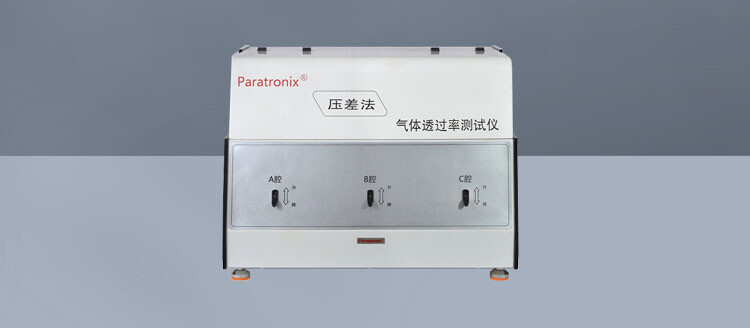
In a common differential-pressure arrangement, the specimen separates a pressurized test-gas chamber from an evacuated receiving chamber. The instrument monitors pressure rise on the receiving side and calculates transmission from that change, using the chamber volume, specimen area, and test conditions.
Because the pressure sensor is not inherently selective for oxygen or carbon dioxide, this approach can support several gases. Oxygen, nitrogen, and carbon dioxide are typical candidates. Other gases may be possible when the instrument’s materials, seals, pressure range, vacuum system, and safety provisions are suitable.
That flexibility has a trade-off: pressure rise does not identify which gas caused it. Leaks, specimen outgassing, and residual moisture can contribute to the signal. Reliable measurements therefore depend on chamber preparation, background checks, stable temperature, and a method appropriate to the specimen’s barrier level.
Gas-selective systems: the detector determines what is measured
Many oxygen transmission rate instruments use a coulometric oxygen sensor. Oxygen passing through the film is carried to the detector by a specified carrier-gas stream. This configuration measures oxygen; it does not become a carbon dioxide or nitrogen analyzer simply because the supply cylinder is changed.
Carbon dioxide transmission systems often use an infrared detector configured for CO₂. Other instruments may use different detection technologies, but the same rule applies: the detector must respond appropriately to the target gas, and the complete measurement path must be validated for that application.
A multi-gas instrument may offer separate detector modules or measurement channels. Ask what “multi-gas” means in practice. It can describe several supported configurations rather than simultaneous measurement of multiple gases in one test.
What changes when the test gas changes?
Oxygen: a common test, but not a universal proxy
Oxygen transmission rate, usually abbreviated OTR, is widely used to assess packaging intended to limit oxygen ingress. It is relevant to oxygen-sensitive pharmaceutical products and many food-packaging applications. Both suitable pressure-based systems and dedicated oxygen-detection systems can measure oxygen transmission.
An oxygen result does not establish the material’s barrier performance against every other gas. Permeation depends on both gas diffusion through the material and gas solubility within it. A multilayer structure that performs well against oxygen may behave differently when exposed to carbon dioxide, especially under different humidity conditions.
Carbon dioxide: important when gas retention matters
CO₂ transmission is relevant where packaging must retain carbon dioxide or control its exchange with the surrounding atmosphere. Examples include carbonated-product packaging and certain modified-atmosphere applications. A suitable pressure-based tester or dedicated CO₂ detection system can provide this measurement.
CO₂ can interact with polymers differently from oxygen or nitrogen. Depending on the material and pressure, sorption and plasticization may influence transport behavior. Consequently, converting an oxygen result into a CO₂ result using a generic ratio is not a dependable substitute for testing the actual material under relevant conditions.
Nitrogen: distinguish the test gas from the carrier gas
Nitrogen transmission can be measured using an appropriately configured pressure-based method or another validated analytical arrangement. It may matter when evaluating nitrogen-flushed packaging, gas retention, or membrane selectivity.
However, nitrogen is also commonly used as a carrier or purge gas in oxygen-testing systems. Its presence in the instrument does not mean the instrument measures nitrogen transmission. In such a configuration, the detector is measuring oxygen transported by the carrier stream, not the carrier itself. This distinction is worth checking explicitly when reading specifications.
Helium, hydrogen, argon, and specialty gases
Some research applications require gases beyond the usual packaging test gases. Helium, hydrogen, or argon may be measurable with suitable pressure-based or specialized analytical systems. Compatibility must still be confirmed for the exact instrument, not inferred from its general operating principle.
Hydrogen introduces flammability considerations. Toxic, corrosive, or reactive gases can require dedicated wetted materials, ventilation, monitoring, and exhaust treatment. A standard packaging tester should not be assumed suitable for these applications. Even inert gases can present handling hazards, while helium’s tendency to pass through small leak paths makes leak control particularly important.
Mixed gases and water vapor need separate questions
Testing a pure gas is not the same as testing a gas mixture. A pressure-based instrument may register the combined pressure increase caused by several permeating components, but that measurement alone cannot separate their individual transmission rates. Component-specific analysis requires suitable detectors or an analytical technique capable of distinguishing the gases.
Mixture composition can also change material behavior. Pure-gas measurements are useful for screening, but they may not fully represent a package containing oxygen, nitrogen, and carbon dioxide together. Where mixed-gas performance affects the decision, confirm whether the proposed method measures individual components under the intended mixture conditions.
Water vapor is another common source of confusion. Although it is a gas-phase substance, water vapor transmission rate, or WVTR, normally requires a moisture-specific method and controlled humidity conditions. An oxygen tester does not automatically measure WVTR. A shared instrument platform may support both tests through separate modules, but the capability must be stated explicitly.
Gas compatibility is only half the selection decision
A tester can support the correct gas and still be unsuitable for the specimen. High-barrier pharmaceutical laminates, for example, require careful attention to low-level measurement capability and background stability. More permeable plastic films may instead challenge the upper measurement range. The relevant question is whether the expected transmission falls within a validated working range—not whether the gas appears on a brochure.
Humidity deserves equal attention. Moisture can change the barrier performance of some polymers, so a dry-gas result may not represent service conditions. Check whether humidity is controlled on one or both sides of the specimen and whether that arrangement matches the intended test method.
Specimen format matters too. A flat-film test characterizes the mounted material, while a finished bottle, pouch, or blister introduces geometry, closures, seals, and potential defects. A film result should not be treated as a complete-package result. Package testing requires appropriate fixtures and a method that defines what is being measured.
Standards help clarify these differences. ASTM D3985 addresses oxygen transmission through plastic film and sheeting using a coulometric sensor, while ASTM D1434 addresses gas permeability characteristics of plastic film and sheeting. Confirm the current standard’s scope and the instrument’s implementation rather than treating either reference as proof of unrestricted gas capability.
What to confirm before choosing a configuration
A useful technical discussion starts with the material and decision you need to make. Give the equipment supplier the target gas, specimen structure, approximate thickness, expected barrier level, and intended temperature and humidity. If the expected transmission is unknown, representative specimens can help establish whether the proposed measurement range is appropriate.
- Exact gas capability: Is the gas supported by the supplied configuration, or does it require another detector, module, or test cell?
- Measurement limits: What validated range, background performance, and uncertainty apply to that gas and method?
- Test conditions: Can the system reproduce the required pressure, temperature, humidity, and gas composition?
- Routine operation: What gas purity, calibration or verification procedure, leak checks, consumables, and maintenance are required?
- Result definition: Does the report provide transmission rate, permeance, or permeability, and which units and reference conditions are used?
These result terms are not interchangeable. Transmission rate describes gas passage per area and time under specified conditions. Permeance accounts for the driving pressure difference; permeability also incorporates thickness where the material model permits it. Comparing reports without checking those definitions can produce misleading conclusions.
Paratronix Instruments Co., Ltd. develops, manufactures, and supplies packaging testing instruments for pharmaceutical packaging, plastic packaging materials, and high-barrier materials. For a packaging-testing solution provider, the useful starting point is matching the measurement method to the application—not assuming that every Gas Transmission Rate Tester measures the same gases.
Before selecting equipment, ask for written confirmation of the target gas, installed detection method, compatible specimen format, and supported test conditions. Oxygen, carbon dioxide, nitrogen, and specialty gases are all possible measurement targets, but only the right configuration makes the resulting number meaningful.
Leave A Reply
Search by Keywords