




Recent Posts
 How to assess a Luer separation force tester against ISO 80369-20Nov 02, 2026
 What does ISO 80369-7 require for Luer lock unscrewing tests?Nov 02, 2026
 What does a Luer taper ease of assembly tester measure?Oct 31, 2026
 What does ISO 80369-7 require for Luer ease of assembly tests?Oct 31, 2026
 What Does a Luer Taper Easy Assembly Tester Measure?Oct 30, 2026
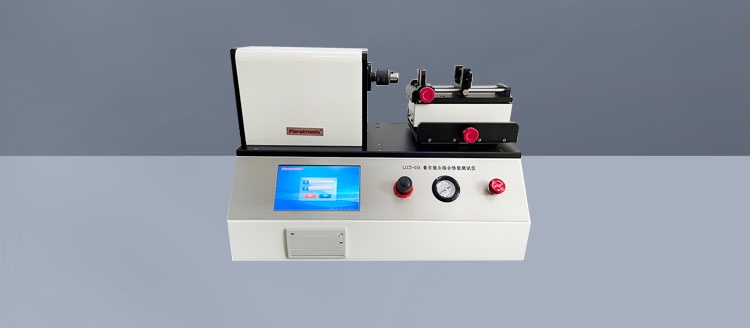
ISO 80369-7 addresses the resistance of Luer lock connections to unscrewing as part of the performance requirements for small-bore connectors used in intravascular or hypodermic applications. The assessment concerns a connection assembled under specified conditions and subjected to a defined unscrewing test. It is not simply a check that a connector can be opened, nor is any measured breakaway torque automatically a pass or fail.
A defensible result depends on the applicable edition of ISO 80369-7, the associated test method in ISO 80369-20, the type of connector under evaluation and the acceptance criteria specified for that configuration. The controlled standards should be consulted for the exact assembly conditions, test sequence, applied torque or measurement requirements, duration and pass/fail limits. Those details should not be inferred from an instrument’s default settings or from a generic test procedure.
What the unscrewing requirement is intended to assess
A Luer lock connection combines a tapered fluid connection with a locking mechanism. The tapered surfaces help establish the fluid path seal, while the locking features retain the mating parts. Resistance to unscrewing addresses whether the threaded connection can remain engaged when exposed to the rotational challenge defined by the standard.
That question is distinct from whether the connection can be disconnected deliberately. A user may need to separate the components at the appropriate point in a procedure, but a test result for resistance to unscrewing should be interpreted against the standard’s specified acceptance criterion—not against an assumed ideal opening force.
It is also distinct from leakage performance. A connection can resist rotation yet fail a separate leak test, or it can seal under one set of conditions without demonstrating adequate resistance to unscrewing. The locking threads, taper fit, material properties and assembly conditions contribute differently to these outcomes. Passing one test does not substitute for the other.
The same distinction applies to resistance to separation by an axial load and to overriding of the locking features. These are related mechanical concerns, but they involve different loading modes and failure mechanisms. A complete connector evaluation requires the tests applicable to the connector and its intended use, rather than a single torque measurement presented as proof of overall performance.
How ISO 80369-7 and ISO 80369-20 fit together
ISO 80369-7 is the application-specific part of the ISO 80369 series for connectors with 6% (Luer) taper used in intravascular or hypodermic applications. It specifies design and performance requirements for the connectors within its scope. ISO 80369-20 supplies common test methods used by the series, including methods relevant to mechanical performance.
The two documents have different roles. The application-specific standard establishes which requirements apply and how conformity is judged; the common-method standard describes how specified tests are performed. A laboratory procedure therefore needs to connect the relevant requirement in ISO 80369-7 to the correct method in the referenced edition of ISO 80369-20.
Edition control matters. A test report that names “ISO 80369” without identifying the applicable parts and editions leaves uncertainty about the procedure and criteria used. The same is true when a laboratory relies on an older internal method without checking whether its referenced standard is the one required for the current evaluation. Amendments, national adoptions and other applicable product standards may also affect the documentation needed for a particular conformity assessment.
Before testing, the controlled procedure should identify the connector being evaluated, its mating configuration, the applicable requirement, the referenced test method and the acceptance criterion. If a contractual or regulatory submission calls for a particular edition, that edition must be distinguished from a later publication that the laboratory happens to hold.
What is tested in practice
The object of the test is the assembled connection, not the torque instrument in isolation. The condition of both mating components and the way they are brought together determine what the unscrewing challenge represents.
The applicable method may prescribe the use of a reference connector or another defined mating component. That choice matters because thread geometry, taper dimensions, surface finish and material stiffness affect engagement. A result obtained with one mating part cannot automatically be transferred to every commercially available Luer connector, even when the parts appear compatible.
Assembly is equally important. A connection tightened more heavily before the test can behave differently from one assembled at a lower torque. Axial force during engagement, relative rotation, alignment and any specified conditioning can also affect the final state of the joint. These are controlled test variables, not details to leave to the operator’s preference.
The specimen should be prepared and assembled according to the applicable method, including any requirements for preconditioning, reference components and the use or avoidance of treatments such as lubrication. Components should not be cleaned, wetted or modified simply to improve handling unless that treatment is specified or separately justified as part of a documented evaluation.
After assembly, the connection is subjected to the unscrewing procedure specified by the applicable standards. The procedure may require a defined torque challenge and an observation of the connection, a measured torque value, or both, depending on the requirement being applied. The report must preserve that distinction. A torque value recorded by the equipment is not, by itself, evidence that every required condition and observation was satisfied.
Applied torque and opening torque are not interchangeable
A common source of confusion is the difference between the torque imposed during a resistance test and the torque required to initiate or continue separation. Both are expressed in torque units, but they answer different questions.
Applied unscrewing torque is the rotational load delivered to the connection under the test conditions. Where the method calls for a specified challenge, the important issue is whether that challenge was applied in the required direction, manner and duration, and whether the specimen met the stated acceptance criterion.
Breakaway or opening torque is a measurement associated with the torque needed to start loosening an assembled connection. Its numerical value depends on the method used to detect the start of movement, the instrument’s sampling and peak-capture behavior, and the state of the connection before measurement. It can be useful for process monitoring or product development, but it should not be described as an ISO pass/fail result unless the applicable method and criterion support that interpretation.
For example, a laboratory may record a peak torque while rotating a connector to disconnection as an internal comparison between production batches. That can reveal a change in assembly behavior. It does not necessarily reproduce a standards-based resistance test if the prescribed load profile, observation or endpoint differs. Both results can be valuable, but they should be labeled separately.
Equipment capabilities that affect the validity of a result
A Luer Taper unwinding torque tester must do more than display a number. Its suitability depends on whether it can reproduce and document the conditions required by the selected method.
The torque measurement system needs an appropriate range and resolution for the specified challenge. Calibration should be traceable, current and relevant to the direction and range of use. A device calibrated for a broad torque range is not automatically fit for a small connector test if its uncertainty or resolution is inadequate at the required value.
The fixture is just as consequential. It must hold the relevant connector components securely without crushing, bending or distorting them. Excessive gripping force can change the geometry of a plastic hub or collar; inadequate gripping can let the specimen slip and make the instrument measure fixture movement instead of joint behavior. The operator should be able to distinguish movement at the connection from movement elsewhere in the setup.
Alignment also requires attention. Off-axis mounting can introduce bending or side loads into a test intended to apply torque. Such loads may alter friction at the taper or threads and can make results less repeatable. Where the method specifies how axial force is controlled during assembly or testing, the fixture and operating procedure must support that control rather than relying on an operator to approximate it.
Depending on the method, relevant equipment functions can include controlled torque application, measurement of torque and angular movement, peak recording, timing and a way to observe whether the connection has unscrewed. Not every feature is mandatory for every procedure. The decisive question is whether the complete setup can carry out the specified method and produce the evidence needed for its acceptance decision.
Why repeat results can differ
Variation in unscrewing behavior does not necessarily originate in the test instrument. It can arise from the connector, the mating component, specimen preparation or the sequence of testing. Troubleshooting should therefore start with the recorded conditions rather than an immediate adjustment to the acceptance limit.
Material deformation is one example. Plastic locking features can respond to assembly load and time under load. If one set of specimens is tested immediately after assembly and another is held for a different period, the results may not be directly comparable. Temperature and conditioning can also affect material behavior, making adherence to the specified environment important.
Previous handling can change the connection. Repeated assembly and disassembly may alter friction surfaces or damage locking features. A specimen used for another mechanical test may no longer represent the state required for the unscrewing assessment. Reuse is appropriate only where the governing procedure permits it and the test sequence does not invalidate the result.
The mating component is another potential source of variation. Wear, damage or contamination on a reference connector can affect how consistently specimens engage. Its identification, condition and maintenance should be controlled so that an apparent production shift is not caused by a changed test interface.
When results differ between laboratories, comparing only the reported torque is rarely enough. The investigation should include the standard editions, connector configuration, reference component, assembly conditions, fixture design, calibration, environmental conditions and method of detecting the endpoint. A numerical agreement is meaningful only when the procedures being compared measure the same thing.
What a defensible test record should show
A report should allow another qualified party to understand exactly what was tested and how the conclusion was reached. At a minimum, the record should identify the specimen and lot, connector configuration, relevant standard parts and editions, test method, mating component, equipment identification, calibration status and test conditions.
It should also capture the assembly and test settings required by the method, the number of specimens, individual observations or results, the applicable acceptance criterion and the final disposition. Deviations should be identified rather than hidden inside a general statement of compliance. If an internal opening-torque measurement was added to the standardized assessment, it should be reported as an additional measurement with its own method and purpose.
A failed result calls for investigation of both the specimen and the validity of the test. A passed result supports conformity only for the requirement, configuration and conditions assessed. Neither outcome alone establishes compatibility with every mating connector, confirms leak-tightness under all conditions or demonstrates complete compliance with every applicable medical-device requirement.
The strongest unscrewing-test decision is therefore a traceable one: the specified connection was assembled and challenged using the correct controlled method, the relevant acceptance criterion was applied, and the report makes clear what the result does—and does not—establish.
Leave A Reply
Search by Keywords