




Recent Posts
 ASTM D642 and ISO 12048: Requirements for Package Compression TestingOct 12, 2026
 What Does a Paper Thickness Tester Measure, and Why Does It Matter in QC?Oct 12, 2026
 How test speed affects lipstick breaking strength resultsOct 10, 2026
 Choosing a Water Vapor Transmission Rate Tester for flexible filmsOct 10, 2026
 How to select a friction peel tester for flexible packaging filmsOct 09, 2026

Thin Film Tensile Testing Under ASTM D882: Avoiding Grip Slip and Premature Breaks
Reliable ASTM D882 results depend on more than selecting the right thin film tensile tester. For operators testing flexible packaging films, grip slip, jaw damage, and premature breaks can distort tensile strength, elongation, and modulus data. A specimen that slips by only a small amount may appear to have higher elongation than it actually does. A specimen that is crushed or nicked at the jaw may fail early and report an artificially low tensile strength.
These problems are especially familiar in packaging laboratories. Polyethylene film, CPP, BOPP, PET, nylon, laminated structures, metallized films, and high-barrier materials do not all behave the same way in a tensile test. Some are smooth and difficult to grip. Some are very thin and sensitive to jaw pressure. Others stretch substantially before break, making gauge-length control and extension measurement more important than many operators expect.
ASTM D882 is widely used for determining tensile properties of thin plastic sheeting and film. However, the standard method cannot compensate for poor specimen preparation or unsuitable grips. The practical work happens before the crosshead starts moving: selecting representative material, cutting consistent strips, preparing the jaws, setting alignment, and deciding whether the observed failure is valid or merely a gripping artifact.
ASTM D882 Is a Test Method, Not a Substitute for Good Setup
In routine quality control, ASTM D882 is often reduced to a few familiar outputs: tensile strength, elongation at break, yield behavior where applicable, and modulus. Those values are useful only when the specimen undergoes a controlled uniaxial pull through the intended gauge section. If movement occurs inside the grips, the machine extension no longer represents only specimen deformation. If failure begins at the grip edge, the result may describe jaw-induced damage rather than the film itself.
The current purchased edition of ASTM D882 should always govern the formal procedure, including specimen dimensions, conditioning, test speed, calculation methods, and reporting requirements. Laboratories should also verify any customer specification, internal method, or product standard that supplements ASTM D882. Packaging supply chains often use the same base method while requiring a particular direction of test, number of replicates, conditioning environment, or reporting format.
One common mistake is to treat machine settings as universal. A thin, extensible sealant film and an oriented high-barrier web may need very different practical grip arrangements even when both are tested under ASTM D882. The principle remains the same: the grip must hold the specimen without allowing movement, tearing the film, creating a severe stress concentration, or introducing bending and misalignment.
Grip Slip Usually Starts Before the Test Begins
Slip is not always obvious. In severe cases, the specimen visibly creeps out of one jaw. More often, it shifts gradually during the early loading stage, especially with glossy, low-friction films. The force-extension curve may still look plausible at a glance, but elongation and modulus can be affected. For a highly extensible film, the error may remain hidden until results are compared with a different shift, operator, or laboratory.
The first check is simple: mark the specimen close to the outer edge of each grip before testing. After the test, inspect whether the marks have moved relative to the jaw boundary. This is a practical troubleshooting step, not a replacement for a documented method, but it quickly distinguishes true material extension from grip movement.
Contamination is another overlooked source of slip. Films used in packaging may carry slip additives, antiblock agents, coatings, printing inks, adhesive residue, or traces of process oils. Even clean-looking jaw faces can become polished by repeated use. Smooth metal grips and a smooth film surface are a poor combination when the material is thin, slippery, or highly oriented.
Practical ways to improve holding without crushing the film
- Clean grip faces regularly and inspect them for wear, embedded debris, adhesive buildup, or damaged serrations.
- Use grips with an appropriate surface texture for the film. Serrated, rubber-faced, wave-faced, or pneumatically controlled grips may each be suitable in different situations.
- Keep the specimen centered and inserted to the same depth in both grips. Unequal insertion can create an unintended bending or peel force.
- Apply enough clamping force to prevent movement, but not so much that the jaw edge cuts, embosses, or permanently weakens the specimen.
- For difficult films, evaluate tabs or other documented gripping aids only when they are compatible with the applicable method and reporting requirements.
Pneumatic grips can be helpful because they provide more repeatable closing force than manually tightened jaws. That does not mean they are automatically correct for every material. Excessive pneumatic pressure can damage a soft polyethylene film just as effectively as an over-tightened manual grip. The useful setting is the lowest pressure that prevents measurable slip under the intended test conditions.
Premature Breaks at the Jaw Are a Data-Quality Warning
A break near the grip does not always invalidate a test, but it should never be ignored. The key question is whether the failure occurred because the material naturally concentrated stress there or because the gripping system introduced damage. With thin films, the answer is often visible after a careful look at the broken ends.
A clean fracture well inside the gauge section is generally more convincing than a break beginning at a sharp jaw impression. Repeated failures at nearly the same distance from one grip are particularly suspicious. So are tears that start from a serration mark, a folded edge, a nick from specimen cutting, or a region where the film was visibly flattened by the jaws.
Changing only the grip pressure is rarely the complete answer. Very aggressive serrations may stop slip but produce a new failure mode: local notch damage. In practice, grip selection is a balance between friction and specimen protection. This balance should be established during method development, then documented so that different operators do not solve slip by applying inconsistent clamping force.
Specimen Preparation Has More Influence Than It Seems
A tensile tester cannot correct a poor test strip. Uneven width, jagged edges, accidental nicks, curled samples, and inconsistent orientation all create avoidable variation. This is especially important for oriented films, where machine direction and transverse direction can show distinctly different tensile behavior. Mixing directions in one result set is not a minor paperwork issue; it makes the comparison meaningless.
Cutting tools should produce clean, parallel edges. A dull cutter can leave a small edge defect that becomes the initiation point for a premature break. Operators often notice this only after several specimens fail early. A quick inspection under good lighting is usually enough to catch rough edges, folded sections, delamination at a laminate edge, or damage from sample handling.
Thickness measurement also deserves discipline. Tensile stress is calculated from force and original cross-sectional area, so variation in thickness directly affects reported stress. For multilayer packaging films, measured thickness should represent the actual structure being evaluated. If a local coating, embossed area, print layer, or material transition is present, sampling locations should be chosen consistently and reported according to the laboratory procedure.
Conditioning is often treated as a formality until results become difficult to reproduce. Hygroscopic films, nylon-containing structures, and some coated materials can be sensitive to environmental history. Even films with limited moisture sensitivity may behave differently when tested immediately after exposure to unusually hot, cold, or humid production conditions. The applicable standard and product specification should define conditioning expectations; where they do not, the laboratory should establish a consistent internal approach rather than allowing each shift to improvise.
Alignment, Preload, and Extension Measurement Affect the Curve
A specimen should be straight, centered, and free from visible slack when the test begins. Slack can distort the initial region of the force-extension curve and make modulus calculations unstable. Pulling the film taut by hand is not a good substitute for a controlled setup because it can introduce inconsistent pre-tension. Where the method calls for a preload or defined starting condition, it should be applied consistently.
Misalignment introduces another subtle problem. If the upper and lower grips are not on the same loading axis, the film may experience a combination of tension, bending, and local peel at the jaw. Very thin specimens reveal this quickly. One side may wrinkle, the test strip may twist, or the break may repeatedly occur near one clamp. Before blaming the material, inspect whether the grips close parallel and whether the specimen is mounted squarely.
For extension-sensitive properties, consider what the instrument is actually measuring. Crosshead travel includes system compliance and any movement at the grips. Depending on the test objective and the equipment configuration, an extensometer or other appropriate extension-measurement approach may provide a more direct indication of specimen strain. The choice must remain compatible with the applicable ASTM D882 procedure and the laboratory’s validated method.
A Repeatable Workflow for Flexible Packaging Film
The most reliable laboratories do not wait for an outlying result to investigate their setup. They build a short pre-test routine into every batch. Confirm the material identity and test direction. Verify specimen width, thickness procedure, and conditioning status. Inspect cut edges. Check that grips are clean and undamaged. Mount the strip without twist, use the established jaw pressure or tightening practice, and observe the first few tests closely rather than relying only on final numbers.
After testing, look at the physical specimen before approving the data. A force value alone cannot show whether slip occurred or whether a fracture initiated from jaw damage. Retaining failed specimens or at least documenting unusual fracture locations can be valuable when investigating batch-to-batch variation. This is particularly useful for high-barrier and laminated films, where a tensile anomaly may originate from the film structure, adhesive interface, coating condition, or test setup.
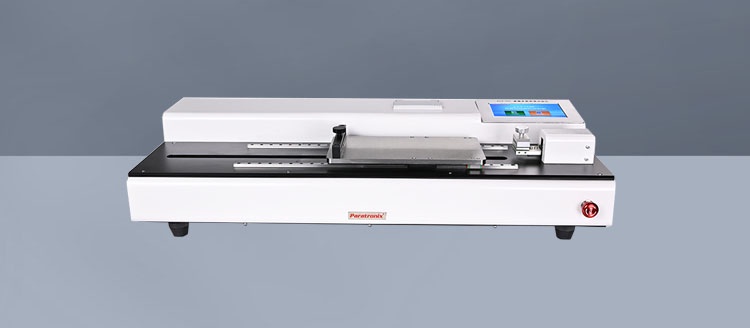
For packaging laboratories working across pharmaceutical packaging, plastic packaging materials, and barrier structures, the thin film tensile tester should be treated as part of a complete testing process rather than an isolated machine. Paratronix Instruments Co., Ltd. develops packaging testing instruments and testing solutions for these applications, where practical details such as grip design, specimen handling, and reporting consistency often determine whether a tensile result can support a real quality decision.
When grip slip or premature breaks appear, repeating the test without changing anything usually just creates more questionable data. Inspect the fracture, check for jaw movement, review specimen quality, and adjust one controlled variable at a time. A valid ASTM D882 tensile test is not simply a film pulled until it breaks; it is evidence that the measured break belongs to the material, not to the grips.
Leave A Reply
Search by Keywords