




Recent Posts
 How test speed affects lipstick breaking strength resultsOct 10, 2026
 Choosing a Water Vapor Transmission Rate Tester for flexible filmsOct 10, 2026
 How to select a friction peel tester for flexible packaging filmsOct 09, 2026
 Key Specifications to Compare When Selecting a Lipstick Break Force TesterOct 08, 2026
 What Does a Lipstick Break Force Tester Measure in Quality Control?Oct 08, 2026

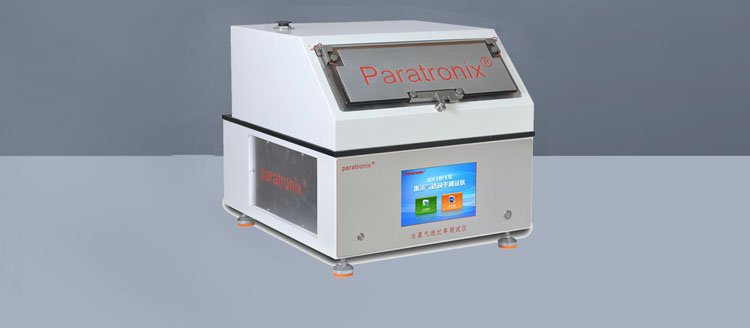
Inside a Water Vapor Permeability Tester: Methods, Sensors, and Test Data
For moisture-sensitive products, a packaging material is only as reliable as its measured barrier performance. That sounds straightforward, but water vapor testing is rarely a matter of placing a film in an instrument and reading a number. A result can be affected by the chosen method, specimen preparation, sealing quality, conditioning, sensor behavior, and the way the laboratory defines equilibrium.
A Water Vapor Permeability Tester is used to determine how readily water vapor passes through films, sheets, coated substrates, laminates, and certain finished package structures. The resulting water vapor transmission rate, commonly called WVTR, helps technical teams assess whether a material can support a specified shelf-life target, protect an active pharmaceutical ingredient, reduce moisture uptake in powders, or maintain the intended properties of a food, electronics, or high-barrier product.
For technical evaluation, the useful question is not simply, “Which film has the lowest WVTR?” It is: “Was this value produced under conditions that represent the application, using a method suitable for the expected barrier range, and can the result be reproduced?” That distinction prevents a great deal of unnecessary material selection work later.
What the Instrument Is Actually Measuring
Water vapor permeability testing is based on a controlled humidity gradient across a specimen. One side of the sample is exposed to higher humidity, while the other side is maintained at lower humidity or swept by a dry carrier gas. Water molecules migrate through the material in response to that difference in water vapor partial pressure. The tester quantifies the vapor reaching the low-humidity side over time.
The reported result is often expressed as water vapor transmission rate in mass per unit area per unit time, such as g/m²·day. Some projects also require permeability rather than transmission rate. These are related but not interchangeable. WVTR describes the tested structure under stated conditions; permeability calculations additionally account for material thickness and the pressure difference used in the test. For multilayer packaging, this matters because thickness alone does not reveal which layer is controlling moisture transport.
A coated polyester film, an aluminum-metallized structure, and a multilayer pharmaceutical laminate may all be called “barrier films,” yet their moisture transport mechanisms can differ. Pinholes, coating discontinuities, poor lamination, polymer crystallinity, adhesive behavior, and edge leakage may all influence the result. The instrument measures the total pathway available to vapor; it does not automatically identify the defect responsible for a high result.
The Main Test Methods and Where They Fit
The test method should be selected before samples are sent to the laboratory. It is common to see material specifications copied from one project to another with only the target value retained, while test temperature, relative humidity, and standard method are omitted. That creates avoidable ambiguity because water vapor transmission is strongly dependent on environmental conditions.
Gravimetric methods
Gravimetric testing is the traditional approach. A test cup containing either a desiccant or water is sealed with the specimen and placed in a controlled atmosphere. The cup is weighed at intervals, and the change in mass is used to calculate moisture transfer. ASTM E96 is widely recognized for water vapor transmission testing by this general cup method.
This approach is practical and well understood, particularly for materials with moderate or relatively high vapor transmission. Its limitations are equally familiar to experienced labs: the test can be slow, balance handling introduces operator dependence, and very high-barrier samples may produce mass changes too small to establish a robust result within a practical period. Cup sealing also deserves close attention. A poor seal can look exactly like a poor barrier film.
Infrared sensor methods
In an infrared method, water vapor passing through the specimen is carried to an infrared detector. ASTM F1249 describes a commonly used procedure for determining water vapor transmission rate through plastic film and sheeting using a modulated infrared sensor. The method is valued for controlled conditions, automated data collection, and comparatively efficient testing of many packaging films.
Infrared detection is often a sensible choice for routine quality control and comparative material work, provided the expected transmission range matches the system capability. The test chamber, humidity generation system, carrier-gas dryness, and sample seal still matter as much as the detector itself. A sophisticated sensor cannot compensate for a specimen that has been wrinkled, contaminated, incorrectly mounted, or damaged around the exposed test area.
Coulometric sensor methods
Coulometric systems detect water vapor through an electrochemical process. ASTM E398 is commonly associated with this approach for sheet materials. These systems are often considered when evaluating low-transmission or high-barrier materials, where the ability to detect small quantities of water vapor becomes particularly relevant.
For high-barrier laminates, the practical challenge is usually not merely sensitivity. It is reaching true equilibrium without mistaking early transient behavior for a finished test. A material can absorb moisture, release residual moisture, or show a gradual stabilization curve. Stopping too early may generate an attractive number that is not representative of steady-state transmission.
Why Sensor Technology Is Only Part of the Answer
When comparing Water Vapor Permeability Tester specifications, it is tempting to focus on the sensor type and the quoted lower detection limit. That figure matters, but it should not be treated as the complete measurement capability of the system. In real use, the effective test performance also depends on blank value, system leakage, environmental stability, specimen area, repeatability, and the operator’s ability to distinguish an actual permeation signal from background noise.
The humidity source is one example. If the upstream humidity fluctuates, the driving force across the specimen changes. If the dry side is not genuinely dry, the measured gradient becomes smaller than assumed. Temperature control is just as important. Polymers often show substantial changes in water vapor transmission as temperature rises, especially near transitions in polymer structure or when plasticization becomes relevant. A result at one condition should not be casually used to predict performance at another.
Modern systems may automate gas flow, temperature, relative humidity, sensor monitoring, and data logging. That automation reduces routine variability, but it does not eliminate the need for method judgment. For instance, a high-barrier sample with a visible crease should generally not be mounted simply because it is the only piece available. The crease may create microdamage that has nothing to do with the nominal material design.
Calibration, Verification, and the Often-Ignored Blank Test
Reliable test data begin before a production specimen enters the chamber. Calibration confirms the response of the measurement system against an appropriate reference procedure or material, while routine verification helps demonstrate that the instrument remains under control between full calibrations. The exact practice should follow the applicable standard, internal quality procedure, instrument documentation, and laboratory requirements.
A blank test is especially useful when results are low. It evaluates the contribution of the chamber, seals, fittings, and system background without the intended specimen providing the barrier. If the blank contribution is unstable or unexpectedly high, there is little value in debating small differences between two high-barrier samples. The system needs attention first.
Reference films are also valuable, but they should be selected thoughtfully. A reference material whose transmission rate is far outside the normal operating range of a project may confirm that the tester is functioning in a broad sense without proving optimum performance at the range that matters most. Technical evaluators should ask what was verified, at which condition, and how the verification result was assessed.
Reading the Data: A Single WVTR Is Not the Whole Story
The final report should identify the specimen, exposed area, test temperature, relative humidity conditions, method, and unit of expression. Without these details, a WVTR value is difficult to compare across suppliers, laboratories, or product revisions. Even a legitimate result can be misleading when the underlying test condition is missing.
The curve behind the final number deserves review where available. A well-behaved test generally shows a stabilization period followed by a steady region suitable for calculation. A drifting curve may indicate that equilibrium has not been reached, that the sample is changing during exposure, or that there is instability in humidity, temperature, flow, or sealing. It is not always a failed test, but it is a result that deserves an explanation before being used in a material approval decision.
Replicate testing is another area where teams can be overly optimistic. One specimen can be useful for screening, but it cannot reveal roll-to-roll variation, coating nonuniformity, or handling damage. If a barrier material is close to a specification limit, additional replicates and sampling from different web positions may be more informative than repeatedly retesting the same retained sample.
Common Evaluation Mistakes in Packaging Projects
- Comparing values from different conditions. A result measured at one temperature and humidity level should not be ranked directly against a result obtained under another condition.
- Using flat-film data as a finished-package guarantee. Seals, folds, punctures, closures, forming stresses, and package geometry can change real-world moisture protection.
- Ignoring the barrier contribution of adhesives and coatings. A laminate is a system. Replacing one adhesive, primer, or coating process can alter results even when the base film is unchanged.
- Assuming a lower number is always commercially better. The appropriate barrier level depends on product sensitivity, intended storage condition, target shelf life, package design, and acceptable process cost.
- Testing samples after uncontrolled storage. Films can absorb moisture or be physically damaged during handling. Conditioning and traceable sample history are not paperwork details; they affect confidence in the measurement.
Selecting a Tester for Technical Evaluation Work
The right Water Vapor Permeability Tester should match the material portfolio and the decisions the laboratory needs to support. A facility primarily evaluating standard plastic films may prioritize throughput, routine operation, and fast comparison of incoming materials. A laboratory working with pharmaceutical packaging or high-barrier structures may place greater emphasis on low-level measurement stability, traceable environmental control, data integrity, and the ability to investigate unusual curves rather than merely generate a pass/fail output.
It is also worth looking beyond the main instrument. Ask how specimens are cut and mounted, whether unusual materials can be sealed effectively, how often consumable components require attention, what verification tools are available, and how raw data can be reviewed and retained. Those details shape daily usability far more than a brochure comparison suggests.
Paratronix Instruments Co., Ltd. develops packaging testing instruments for applications including pharmaceutical packaging, plastic packaging materials, and high-barrier materials. In this kind of work, the strongest testing solution is usually not the one with the longest feature list. It is the one that aligns method selection, sample handling, environmental control, and data review with the actual packaging risk being evaluated.
A permeability result becomes genuinely useful when it can be traced back to a controlled method and defended in a technical discussion. Before accepting or rejecting a material, confirm the test condition, inspect the stability of the measurement, review the sample and seal integrity, and decide whether the result reflects the package structure that will actually reach the market. That is where a Water Vapor Permeability Tester moves from being a laboratory instrument to a practical decision tool.
Leave A Reply
Search by Keywords