




Recent Posts
 Key Specifications to Compare When Selecting a Lipstick Break Force TesterOct 08, 2026
 What Does a Lipstick Break Force Tester Measure in Quality Control?Oct 08, 2026
 Validation Records and Test Standards for Artificial Skin Puncture TestingSep 24, 2026
 Force Tester or Universal Testing Machine for Artificial Skin Puncture Tests?Sep 24, 2026
 What Does an Artificial Skin Puncture Force Tester Measure in Needle Testing?Sep 24, 2026

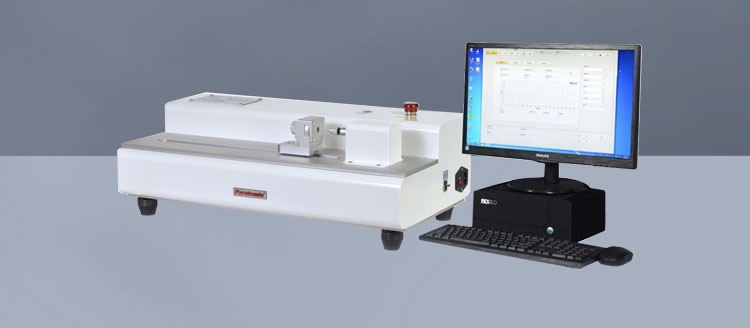
A lipstick break force tester measures how much controlled mechanical force a lipstick stick can withstand before it fractures, bends beyond an acceptable limit, detaches from its base, or suffers another defined form of structural failure. In quality control, its value is not simply that it produces a force number. It converts a familiar but subjective complaint—“the lipstick is too soft,” “it snapped during use,” or “the bullet is unstable”—into a repeatable measurement that can be compared across batches, formulas, production conditions, and packaging designs.
For a cosmetic manufacturer, a lipstick that looks flawless after molding may still fail when extended from its case, exposed to warm distribution conditions, or pressed against the lips at an angle. Break force testing is designed to reveal that hidden weakness before the product reaches consumers. The result helps distinguish whether a failure is more likely related to the bulk formulation, the manufacturing process, the bullet geometry, or the interaction between the lipstick and its package.
What the test actually measures
The central measurement is force, generally recorded as the load applied to the lipstick during a controlled test. Depending on the test method, the instrument may report:
- the maximum force reached before the bullet breaks;
- the force at a specified deflection or displacement;
- the force at which permanent deformation begins;
- the force needed to detach the bullet from the cup or holder;
- the full force-versus-displacement curve during loading.
These outputs are related but should not be treated as interchangeable. A lipstick can resist a relatively high peak load and still be unsuitable if it bends excessively before breaking. Another lipstick may show good stiffness but detach from the mechanism because adhesion between the bullet and its retaining cup is inadequate. A meaningful test specification therefore defines not only a minimum break force, but also the test position, loading direction, extension length, probe type, speed, and failure criterion.
The most useful question is rarely “How strong is this lipstick?” in an abstract sense. It is “Can this lipstick tolerate the mechanical stresses it is expected to encounter in its intended format and use condition?”
Why break force is not the same as hardness
Hardness and break force are often discussed together, but they describe different material behaviors. A hardness test usually evaluates localized resistance to indentation or penetration. It indicates how readily the lipstick surface yields under a small applied contact area. Break force testing evaluates the structural response of the entire extended bullet under a larger, often lateral, load.
A bullet may have a firm surface yet remain vulnerable to snapping because its internal structure is brittle, the bullet is too long for its diameter, or the base connection is weak. Conversely, a softer lipstick may bend under load without fracturing, which can be acceptable or unacceptable depending on the product’s performance target. The break force test therefore captures a combination of stiffness, cohesion, ductility, geometry, and support conditions.
This distinction matters in formulation development. Increasing the wax phase or selecting a harder structuring ingredient may improve certain hardness readings, but it can also increase brittleness if the resulting crystalline network is too rigid. The goal is not automatically the highest possible force value. It is a controlled balance between resistance to damage, smooth application, payoff, sensory feel, and stability across the expected storage temperature range.
How a lipstick break force test is typically performed
A lipstick break force tester generally uses a motorized force-measuring system with a load cell, a fixture that holds the lipstick package or bullet securely, and a probe that applies force at a controlled speed. The lipstick is extended to a predetermined length, often chosen to reflect a vulnerable but realistic consumer-use position. A probe then contacts the bullet at a specified point and applies force until the defined endpoint is reached.
For many stick products, the test resembles a cantilever bending assessment: the bullet is supported at the base and loaded from the side. This arrangement is relevant because sideways loading is a common cause of breakage during application. However, the exact geometry of the method has a major effect on the result. Moving the loading point closer to the base will generally produce a different reading from loading near the tip, even when the lipstick itself is unchanged.
A test record may include the peak force, displacement at peak force, test speed, sample temperature, extension length, contact position, probe dimensions, and observed failure mode. The force-displacement curve can add useful context. A gradual curve may indicate bending and yielding before failure, while a sharp peak followed by an abrupt drop can indicate brittle fracture. Visual inspection remains important because the same numerical result may arise from different physical failures.
What quality teams can learn from the result
A lipstick break force tester is most valuable when used as part of a controlled quality system rather than as an isolated pass-or-fail device. It can support several different decisions.
Batch consistency. If a production batch falls outside an established force range, the deviation may point to variation in raw material quality, processing temperature, cooling history, filling conditions, or aging behavior. A single low result does not identify the cause by itself, but it creates an objective signal for investigation.
Formula screening. During development, comparative testing can show how changes in wax blends, oils, pigments, powders, film formers, or structuring agents alter mechanical robustness. This is particularly useful when a formulation change is intended to improve glide, color payoff, matte effect, or transfer resistance but may unintentionally weaken the bullet.
Package compatibility. The lipstick bullet and the package form one functional system. Cup diameter, retaining features, twist-up mechanism alignment, cap clearance, and support at the base can all affect apparent break resistance. A formula that performs adequately in one package may not behave the same way in another.
Stability evaluation. Testing after storage at selected temperatures or after thermal cycling can reveal whether the bullet becomes softer, more brittle, less adhesive to the cup, or otherwise mechanically unstable over time. This is especially relevant where distribution conditions can expose products to elevated temperatures.
Complaint investigation. When product breakage is reported from the market, comparison of retained samples, complaint samples where available, and current production samples can help determine whether the issue is measurable and whether it is linked to a particular lot, package configuration, or storage condition.
The test result depends heavily on method control
Break force values cannot be meaningfully compared unless the test conditions are aligned. This is one of the most important limitations to understand when reviewing data from different laboratories, suppliers, or product development stages. A reported force value without a test method is incomplete information.
Temperature is particularly influential. Lipstick structures are commonly sensitive to heat because the balance between solid waxes, oils, and other components changes as temperature rises. A bullet tested after inadequate conditioning, or tested at a temperature different from the product’s intended quality-control condition, may produce a misleading result. The same issue applies to time after manufacturing: some formulas continue to crystallize, settle, or change internal structure after filling.
Extension length must also be tightly specified. Extending the bullet farther from the case increases the leverage acting on the base during side loading. Two tests performed at different exposed lengths may produce substantially different break force readings without indicating any formula difference.
Other critical variables include:
- the location and orientation of probe contact;
- probe shape, diameter, and surface condition;
- crosshead or loading speed;
- fixture alignment and package support;
- load-cell capacity and calibration status;
- the definition of failure, especially for products that bend rather than snap;
- the number of specimens used to establish a representative result.
Because these factors matter, internal methods should be documented in enough detail that the test can be repeated by another operator and used consistently over time. Method repeatability is often as important as the headline force value. If the method itself produces wide variation, it becomes difficult to separate genuine product changes from measurement noise.
Breakage is not always a formulation problem
When a lipstick fails a break force target, the immediate assumption may be that the formula is too soft. That can be correct, but it is not the only explanation. The failure pattern often provides more useful direction than the peak-force number alone.
A clean fracture near the base can suggest insufficient support, poor adhesion to the cup, incomplete filling around the retaining area, or stress concentration at the bullet base. A fracture in the middle of the bullet may be associated with structural brittleness, uneven cooling, air inclusions, or geometry that leaves the stick vulnerable at its narrowest section. Excessive bending without fracture may indicate insufficient rigidity, although the package support and extension length must be checked before drawing conclusions.
Manufacturing conditions can also influence the result. Pour temperature, mold temperature, cooling rate, cooling uniformity, remelting conditions, and handling after demolding may affect crystal formation and the distribution of ingredients within the stick. Pigmented formulas add another layer of complexity because dispersion quality and powder loading can influence the continuity of the internal structure.
The package should not be treated as a passive container. If the bullet is poorly centered, rubs against internal components, receives uneven support during extension, or experiences cap contact in transit, the practical risk of damage may differ from what a simple unsupported material test suggests. A robust quality program may therefore combine break force data with visual checks, twist-up performance, cap-fit assessment, and transport-oriented evaluations.
Interpreting a force-displacement curve
A single peak-force value is useful for routine control, but the curve behind that value can reveal more about material behavior. In a typical lateral loading test, force rises as the probe pushes against the bullet. The initial slope reflects resistance to deflection. A steep slope indicates a stiffer response; a lower slope indicates greater flexibility under the same test arrangement.
If the curve reaches a peak and then drops suddenly, the bullet has likely fractured or lost structural support. If force continues to rise while the lipstick bends, the product may be deforming rather than breaking. If the curve becomes irregular, the event may involve cracking, slipping in the fixture, contact with the package, or partial detachment from the cup. Such observations should be checked rather than automatically classified as a formula failure.
For this reason, a lipstick break force tester should be viewed as a system for controlled mechanical characterization, not merely a digital force gauge. The ability to capture displacement, define endpoints, and retain test curves can improve diagnosis when results deviate from expectations.
Setting meaningful acceptance limits
There is no universal break-force threshold that defines a “good” lipstick. The appropriate target depends on bullet size, profile, formula type, package design, intended application behavior, storage expectations, and the company’s own product-quality standard. A slim stick and a conventional full-diameter bullet should not be expected to meet identical force targets. Nor should a highly emollient balm-like product necessarily be judged against a long-wear matte formula.
Acceptance limits are most defensible when they are based on product-specific development work and confirmed against samples judged acceptable in use. Both lower and upper limits can be relevant. A low value may signal an elevated risk of breakage, while an unusually high value may reflect excessive hardness or brittleness that could affect application performance. The quality objective is controlled performance within a suitable range, not maximum resistance at any cost.
Where suppliers, contract manufacturers, and brand owners share test data, agreement on the method is essential. A specification that only states a force value without defining conditioning, extension, probe location, speed, and failure criteria can lead to avoidable disputes. In cross-border supply chains, this level of method clarity is particularly important because the product may be manufactured, tested, packaged, and evaluated by different organizations.
What the tester cannot establish on its own
Mechanical strength is only one element of lipstick quality. A satisfactory break force result does not confirm color uniformity, microbiological quality, chemical stability, sensory performance, compatibility with the package materials, or regulatory compliance. It also does not fully reproduce every real-world event, such as a consumer applying the product with an unusual angle or a package being dropped under uncontrolled conditions.
Its role is narrower but highly practical: it provides a reproducible way to monitor resistance to a defined mechanical load. When the method reflects the product’s actual vulnerabilities, the data can prevent subjective judgments from dominating decisions about stick integrity.
For cosmetic quality control, the most informative use of a lipstick break force tester is therefore comparative. It establishes whether the current product behaves like the approved product, whether a process or material change has altered structural performance, and whether the lipstick-package combination retains sufficient integrity under controlled conditions. Used with a well-defined method and supported by visual and functional assessment, it turns lipstick breakage from a vague consumer risk into a measurable quality characteristic.
Leave A Reply
Search by Keywords