




Recent Posts
 How test speed affects lipstick breaking strength resultsOct 10, 2026
 Choosing a Water Vapor Transmission Rate Tester for flexible filmsOct 10, 2026
 How to select a friction peel tester for flexible packaging filmsOct 09, 2026
 Key Specifications to Compare When Selecting a Lipstick Break Force TesterOct 08, 2026
 What Does a Lipstick Break Force Tester Measure in Quality Control?Oct 08, 2026

Is Seal Strength Testing Required for Food Packaging?
Is seal strength testing required for food packaging? For manufacturers trying to protect freshness, prevent leaks, and maintain consistent product quality, the practical answer is often yes—even where a specific test is not explicitly mandated by a local regulation.
Food packages do more than hold a product. They must survive filling, sealing, cooling, transport, warehousing, retail handling, and consumer opening. A pouch may look properly sealed on a production line yet fail when internal pressure rises, when a frozen product is dropped, or when a liquid product is stacked under load. Seal strength testing gives packaging teams a measurable way to assess whether the seal is likely to remain intact under the conditions it is expected to face.
That does not mean every food manufacturer needs the same testing program. The right approach depends on package format, filling process, product characteristics, distribution environment, customer requirements, and the specifications agreed with film or container suppliers. The more demanding the application, the harder it is to rely on visual inspection alone.
A Regulatory Requirement and a Quality Requirement Are Not Always the Same
The question is often framed too narrowly: “Is seal strength testing legally required?” In many markets, food safety frameworks focus on the suitability of food-contact materials, hygienic production, traceability, and prevention of contamination. They may not prescribe one universal seal-strength value or require every package to be tested by one named method.
However, a lack of a universal legal requirement should not be interpreted as permission to leave seals unverified. Brand owners, retailers, co-packers, export customers, and internal quality systems frequently require documented package performance. In practice, seal-strength data may become necessary for supplier qualification, process validation, complaint investigation, new-material approval, or shelf-life risk assessment.
A food producer selling dry biscuits in a simple flow wrap faces a different risk profile from a producer of retort pouches, vacuum-packed meat, chilled ready meals, stand-up sauce pouches, or modified-atmosphere trays. The question is not simply whether a rule exists. It is whether a weak or inconsistent seal could compromise product protection, create waste, trigger a customer complaint, or make a quality release decision difficult to defend.
What Seal Strength Testing Actually Measures
Seal strength testing measures the force required to separate a heat-sealed area under defined conditions. A specimen is generally pulled apart using a tensile testing instrument, while the applied force and separation behavior are recorded. The result can be expressed as force per unit width, depending on the selected method and reporting practice.
The force value matters, but it is not the whole story. The mode of failure can reveal more about the underlying packaging issue. A seal may peel open cleanly at the intended interface, which can be appropriate for easy-open applications. It may tear through a film layer, suggesting that the seal is stronger than the substrate. Or it may fail inconsistently, with channels, partial bonding, contamination marks, or localized weak areas. Those patterns often point back to sealing temperature, dwell time, pressure, film surface treatment, product contamination, jaw alignment, or material variation.
For flexible packaging, methods such as ASTM F88/F88M are widely referenced for determining seal strength of flexible barrier materials. The applicable method, specimen width, peeling configuration, grip separation speed, conditioning conditions, and acceptance criteria should be defined by the relevant customer specification, product requirement, or internal validation plan. Copying a test setup from another package without checking those details can create misleading comparisons.
When Testing Becomes Particularly Important
Some packaging applications can tolerate a broader process window than others. For products where seal integrity directly affects leakage, oxygen exposure, moisture pickup, or microbial risk, verification should be treated as part of process control rather than a final inspection exercise.
- Liquid, semi-liquid, oily, or powder products that can contaminate the seal area during filling.
- Vacuum and modified-atmosphere packs, where package performance depends on maintaining the intended internal environment.
- Frozen foods and chilled products exposed to cold-chain handling, compression, and impact during distribution.
- High-barrier laminates, where an apparently minor seal defect can undermine the barrier package design.
- Retortable or heat-processed packs, where sealing performance must be considered alongside the full thermal process.
- New packaging materials, downgauged films, recycled-content structures, or changes in sealing equipment.
Testing is also valuable after a process change that seems unrelated to sealing. A different product temperature, a faster line speed, a new filling nozzle, altered jaw coating, or a change in film supplier can all affect the seal area. The trouble is that these changes do not always produce immediate visible defects. A controlled pull test can detect a narrowing seal window before the issue reaches the market.
Seal Strength Is Not the Same as Leak Testing
It is common to confuse seal strength with package leak testing. They answer related but different questions.
A leak test asks whether a package has a channel, pinhole, imperfect seal, or other pathway that allows air, liquid, or gas to pass through under specified conditions. Seal strength testing asks how much force the sealed interface can withstand before separating. A package may have a relatively high average seal-strength result yet still contain a localized channel leak. Conversely, a package can be hermetically sealed but have an opening force that is too low for rough distribution or too high for intended consumer use.
For that reason, many packaging validation plans use more than one test. Depending on the application, the combination may include seal-strength measurement, visual seal inspection, burst or creep testing, vacuum decay or bubble-emission leak testing, and package aging studies. The aim is not to run tests for their own sake. It is to understand whether the package can perform from factory release to consumption.
How to Set a Meaningful Acceptance Criterion
One of the most persistent mistakes in food packaging quality control is selecting a target number without defining the application behind it. A seal strength that is acceptable for one snack pouch may be unsuitable for a heavy liquid pouch, while an intentionally peelable lidding seal should not be judged by the same expectation as a permanent pouch seal.
A useful specification normally considers the package material structure, seal width, package dimensions, product weight, filling temperature, expected distribution stress, opening requirements, and the failure mode considered acceptable. It should also clarify whether the limit applies to an average, a minimum individual result, a range of values, or a defined failure pattern.
For example, a stable average result can hide an occasional weak seal if too few specimens are tested or if samples are cut only from the best-looking area. Sampling should reflect real production conditions: different rolls, machine lanes, shift changes, start-up and steady-state production, and packages made near normal operating limits. A test method only becomes useful when it represents the manufacturing risk being controlled.
The Seal Window Deserves Attention
Seal strength is strongly influenced by the relationship among temperature, pressure, and dwell time. This operating range is often called the seal window. If temperature is too low or dwell time is too short, the seal may be incomplete. If the setting is too aggressive, the film can distort, burn through, wrinkle, or produce a seal that tears unpredictably. Product residue in the seal zone may further reduce consistency.
For packaging development teams, mapping seal strength across a practical range of conditions is usually more informative than testing a single preferred setting. It helps identify whether a process has enough tolerance for ordinary variation on the line. A narrow process window can be manageable, but it demands tighter machine control and closer verification.
Choosing the Right Testing Equipment and Workflow
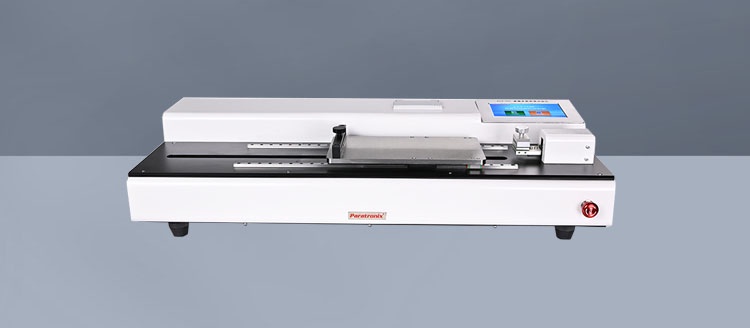
A seal-strength test system should be selected around the package and the intended method, not simply around maximum force capacity. The instrument needs suitable grips for the specimen, stable crosshead movement, adequate force resolution for the expected range, and software or data handling that supports consistent reporting. Poor gripping can cause slippage or premature film breakage, turning a valid package test into an equipment artifact.
Laboratories should also consider how samples will be prepared. Consistent strip width, correct seal orientation, defined conditioning, and a documented testing speed are essential. If operators use different sample widths or grip the material at inconsistent distances from the seal, results may vary for reasons unrelated to actual packaging quality.
For organizations handling multiple packaging formats, it is often practical to build a broader package-performance workflow rather than treating the tensile tester as an isolated device. Film tensile properties, heat sealability, coefficient of friction, oxygen or water-vapor barrier performance, leak resistance, and seal strength can interact. A material selected for excellent barrier performance may need a different sealing process than a conventional laminate.
Common Reasons Good-Looking Seals Fail
Visual inspection remains useful, but it cannot reliably identify every weak bond. Problems that frequently appear in seal-strength investigations include contamination from product or oil, uneven sealing pressure, worn or misaligned jaws, variation in film coating or sealant layers, incomplete cooling before handling, and changes in environmental conditions that affect the packaging material.
Another issue is testing only after a complaint. By then, the production conditions that created the defect may have changed. Routine verification provides a baseline. When a result shifts, the team can compare it with normal production history and investigate before failures become widespread.
The most useful records connect test results to production variables. Recording the film batch, line, machine settings, product type, operator shift, and sample location can turn an isolated failure into a solvable process signal. Without that context, a test report may confirm that a seal failed but offer little guidance on why.
Making Seal Testing Part of a Defensible Packaging Program
For food packaging, seal strength testing is rarely about satisfying a single checkbox. It is a practical control for packages whose seals affect product containment, freshness, safety expectations, or shelf presentation. Whether it is formally required depends on the applicable market rules and contractual specifications. Whether it is advisable depends on the consequences of seal failure—and those consequences are often clear long before a regulation names a particular test.
A sensible starting point is to define the package’s real failure risks, select a recognized or agreed test method, establish acceptance criteria based on the actual application, and verify results across normal process variation. This is particularly important when introducing new materials, modifying packaging machinery, or supplying demanding food categories.
Paratronix Instruments Co., Ltd. develops packaging testing instruments and comprehensive testing solutions for applications including pharmaceutical packaging, plastic packaging materials, and high-barrier structures. For food-packaging teams, the relevant discussion is not merely which instrument to purchase. It is how specimen handling, test configuration, seal behavior, and related package-integrity tests can support a repeatable quality decision. Before setting up a program, confirm the package format, expected seal mode, applicable customer or market requirements, and the production conditions the test must represent.
Leave A Reply
Search by Keywords