




Recent Posts
 How to perform an ampoule break force test according to ISO 9187-1Oct 19, 2026
 How Bone Screw Self-Tapping Testers Measure Axial Force and Tapping TorqueOct 17, 2026
 ASTM F543 Bone Screw Pull-Out Testing: Setup and Reporting RequirementsOct 17, 2026
 What does a lipstick breaking strength tester actually measure?Oct 16, 2026
 What Does an Adhesive Tack Tester Measure in Pressure-Sensitive Tapes?Oct 15, 2026


Introduction
Water vapor transmission rate (WVTR) is one of the most critical performance indicators for packaging films, flexible materials, rigid sheets, and barrier coatings. It directly determines the moisture barrier capacity, shelf life protection, and environmental adaptability of materials in food, pharmaceutical, electronic, and new energy industries. As a classic, authoritative, and widely recognized testing solution, the gravimetric WVTR tester has become the mainstream standard equipment for material water vapor permeability testing worldwide due to its high accuracy, stable performance, and full compliance with international and national testing standards.
1. Testing Principle of Gravimetric WVTR Tester
The gravimetric testing method, also known as the dish method, adopts the fundamental physical principle of moisture mass transfer and weight difference measurement. The core testing logic is based on the stable moisture gradient difference on both sides of the test specimen.
During the test, the standard specimen is tightly sealed on the top of a test dish filled with distilled water or desiccant to isolate internal and external air circulation. The test chamber maintains constant temperature and humidity conditions to form a stable water vapor pressure difference across the specimen. Water vapor penetrates through the material barrier layer at a specific rate, causing continuous weight changes of the test dish system. A high-precision analytical balance continuously monitors and records real-time weight variations. After the test reaches a stable penetration state, the system automatically calculates the water vapor transmission rate, water vapor permeance coefficient, and other core parameters of the specimen based on weight change data, test area, and testing duration.
This principle relies on direct physical weighing instead of indirect sensor deduction, ensuring authentic, intuitive, and traceable test data, which is irreplaceable for authoritative quality inspection and laboratory calibration.
2. Compliant International & Industrial Standards
Our gravimetric WVTR tester is fully developed and calibrated in accordance with global mainstream testing standards, covering international, American, European, and Chinese national specifications, ensuring test results are universally recognized and applicable for product certification and cross-border trade detection:
- ISO 2528:2017 — Sheet materials — Determination of water vapour transmission rate (Gravimetric dish method)
- ASTM E96/E96M-23 — Standard Test Methods for Water Vapor Transmission of Materials
- ASTM D1653 — Water Vapor Transmission of Flexible Barrier Materials
- GB/T 1037 & GB/T 16928 — Chinese national standards for plastic film and sheet water vapor permeability test
- DIN 53122-1, TAPPI T448/T464, JIS Z0208 — European and Japanese industrial standards
- YBB00092003 — Pharmaceutical packaging material testing standard
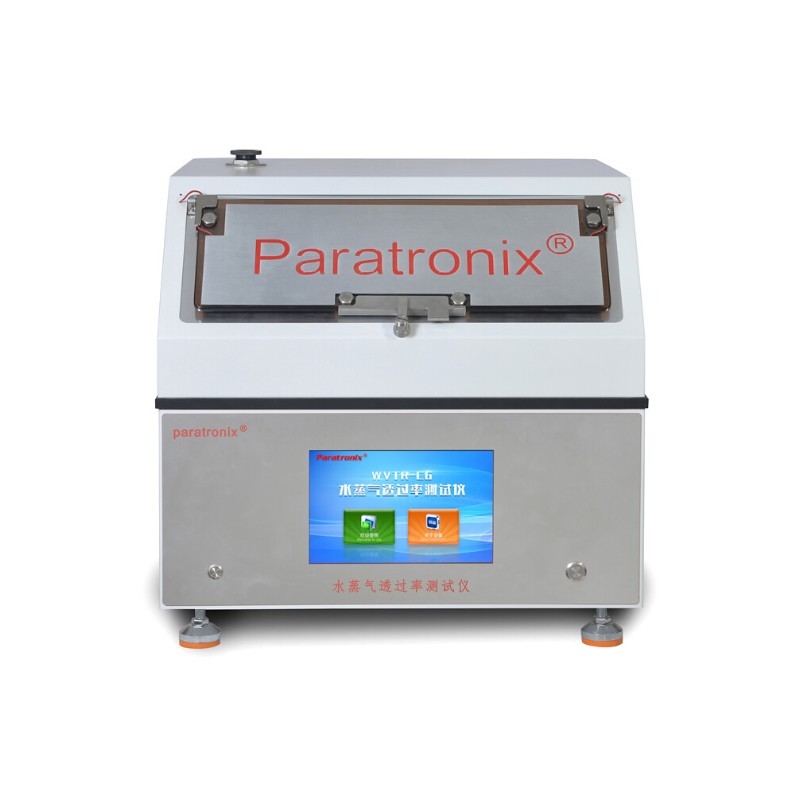
Testing equipment:WVTR-C6 Water Vapor Transmission Rate Tester
3. Core Product Features & Technical Advantages
Different from conventional simplified testing equipment, our upgraded gravimetric WVTR tester integrates precision mechanical control, constant temperature and humidity simulation, and intelligent data analysis systems, with outstanding advantages in accuracy, stability, and operability:
3.1 High Testing Accuracy & Stability
Equipped with a high-precision analytical balance with 0.1mg resolution, the equipment captures tiny weight changes accurately. The independent constant temperature and humidity test chamber adopts a uniform air circulation design, effectively eliminating local temperature and humidity deviations, ensuring a stable moisture gradient environment throughout the test process and avoiding data fluctuation caused by environmental interference.
3.2 Intelligent Automatic Testing Process
The device supports unattended automatic testing throughout the whole process. After specimen placement and parameter setting, the system automatically completes constant temperature and humidity stabilization, timed weighing, data recording, and curve drawing. It intelligently judges the penetration stable state to terminate the test automatically, effectively avoiding manual operation errors and greatly improving testing efficiency.
3.3 Multi-Station Efficient Testing
Configured with multiple independent test stations, the tester can complete simultaneous testing of multiple specimens or comparative testing of different materials under consistent environmental conditions. It ensures high test parallelism while greatly saving test time and meeting batch detection requirements of enterprises and third-party laboratories.
3.4 Wide Testing Adaptability
It supports testing of various materials including plastic films, composite flexible packaging materials, aluminum foil sheets, waterproof coatings, paper boards, and new energy battery barrier films. By adjusting test dishes and sealing fixtures, it can adapt to specimens of different thicknesses and sizes, covering diverse industrial testing scenarios.
3.5 Traceable & Exportable Test Data
The system automatically stores all test data, real-time weight change curves, and environmental parameter records. It supports one-click export of professional test reports, meeting the data traceability requirements of enterprise quality control, third-party inspection institutions, and industrial certification audits.
5. Industrial Application Scenarios
The gravimetric WVTR tester is widely applied in quality inspection and R&D verification of multiple industries, serving as a core barrier performance testing equipment:
Food Packaging Industry: Test the moisture barrier performance of snack packaging, vacuum packaging, and fresh-keeping films to prevent food from deliquescence, mildew, and deterioration, and extend product shelf life.
Pharmaceutical Packaging Industry: Detect the water vapor permeability of medical blister films, pharmaceutical composite packaging, and medicinal paper-plastic materials to ensure the stability of pharmaceutical ingredients and comply with pharmaceutical packaging safety standards.
New Energy Industry: Test the barrier performance of battery packaging films and waterproof and breathable materials to prevent battery core from moisture corrosion and ensure battery safety and service life.
Electronic & Electrical Industry: Verify the moisture-proof performance of electronic component packaging and insulating films to avoid circuit failure caused by moisture penetration.
Building Materials Industry: Detect the water vapor permeability of waterproof coatings, building heat preservation sheets, and decorative films to evaluate material moisture-proof and breathable performance.
Conclusion
As a standard and authoritative testing device for water vapor permeability performance, the gravimetric WVTR tester relies on mature testing principles, precise control technology, and wide standard compatibility, becoming an essential quality testing equipment in barrier material industries. With reliable test performance and efficient testing capability, it provides strong technical support for enterprises’ quality control, product R&D, and global market compliance certification.
Leave A Reply
Search by Keywords